
| Compact SUV; Built in Canada, Japan |
|
|
| Good condition price range: $1,000 – $2,800* |
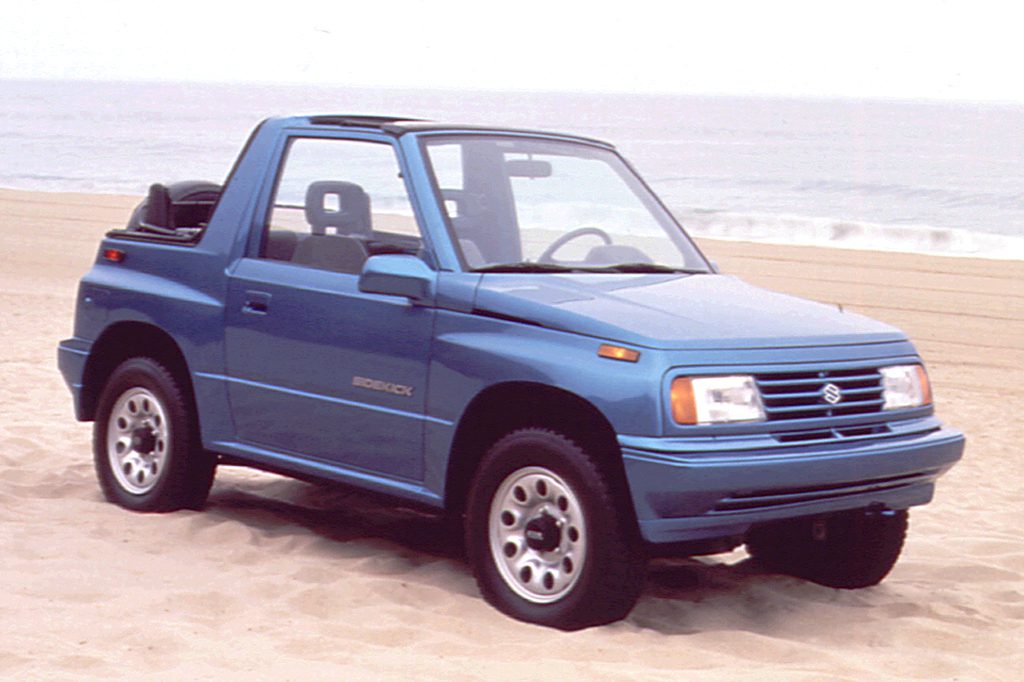
1992 Suzuki Sidekick 2-door convertible
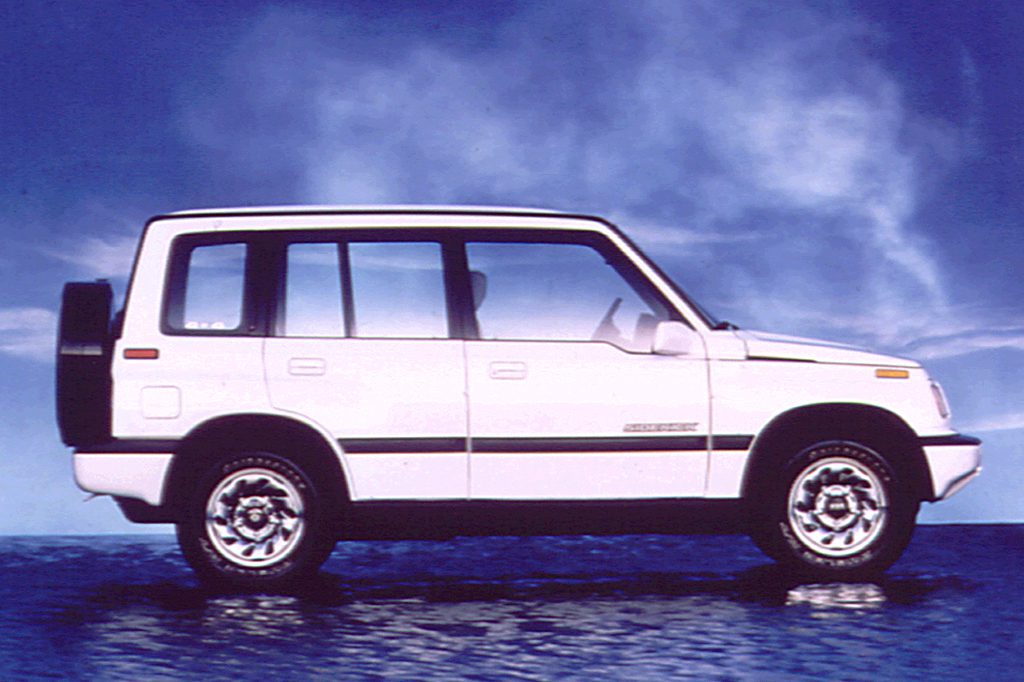
1994 Suzuki Sidekick 4-door wagon
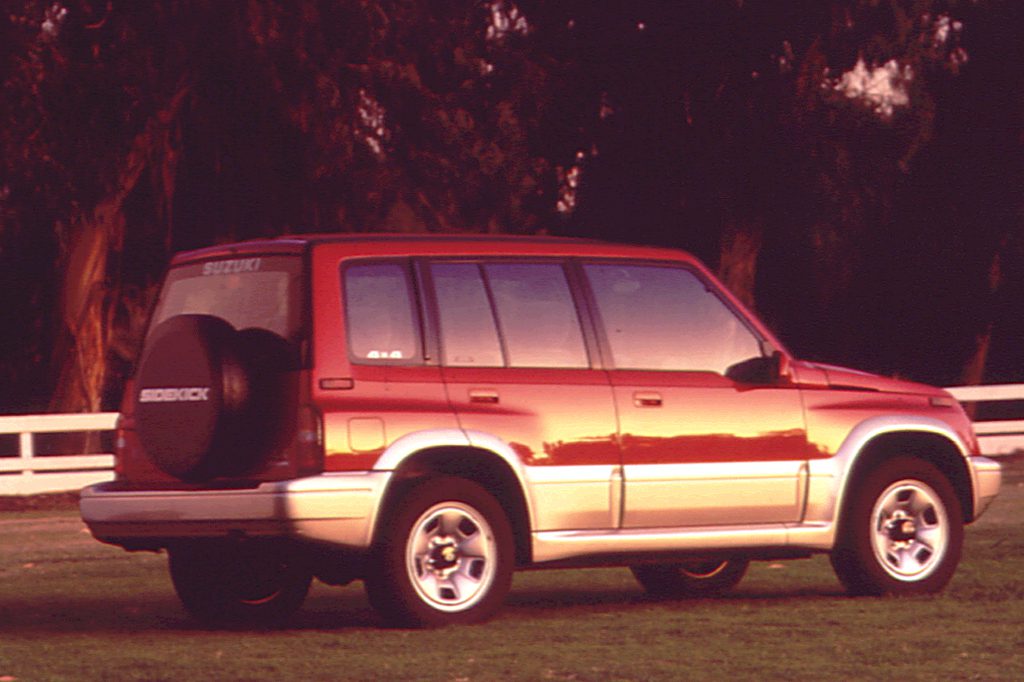
1996 Suzuki Sidekick Sport 4-door wagon
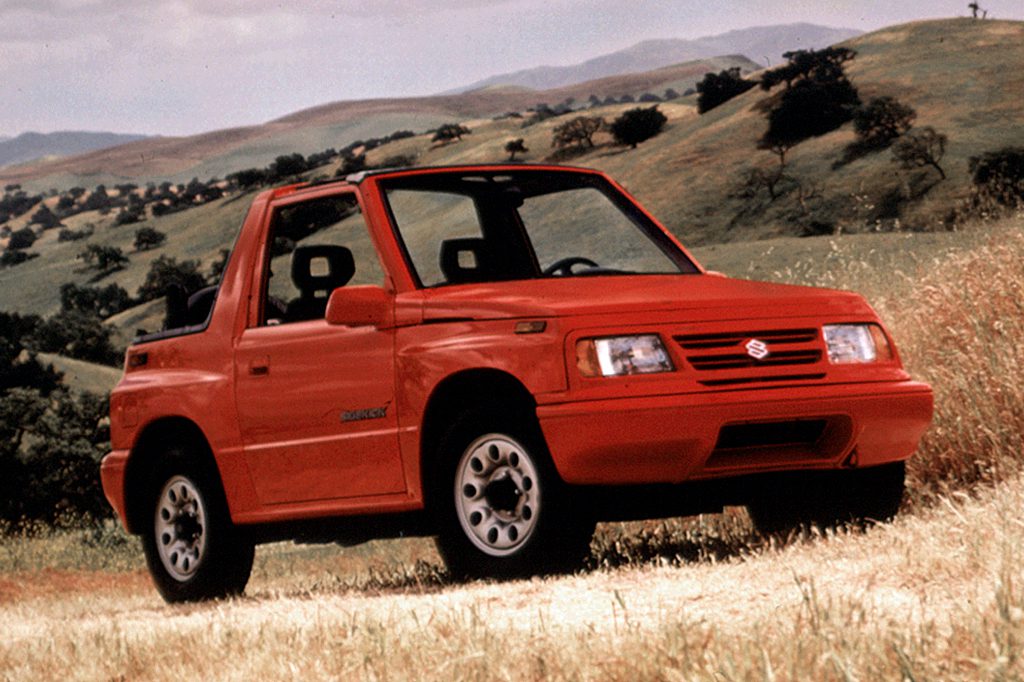
1997 Suzuki Sidekick 2-door convertible
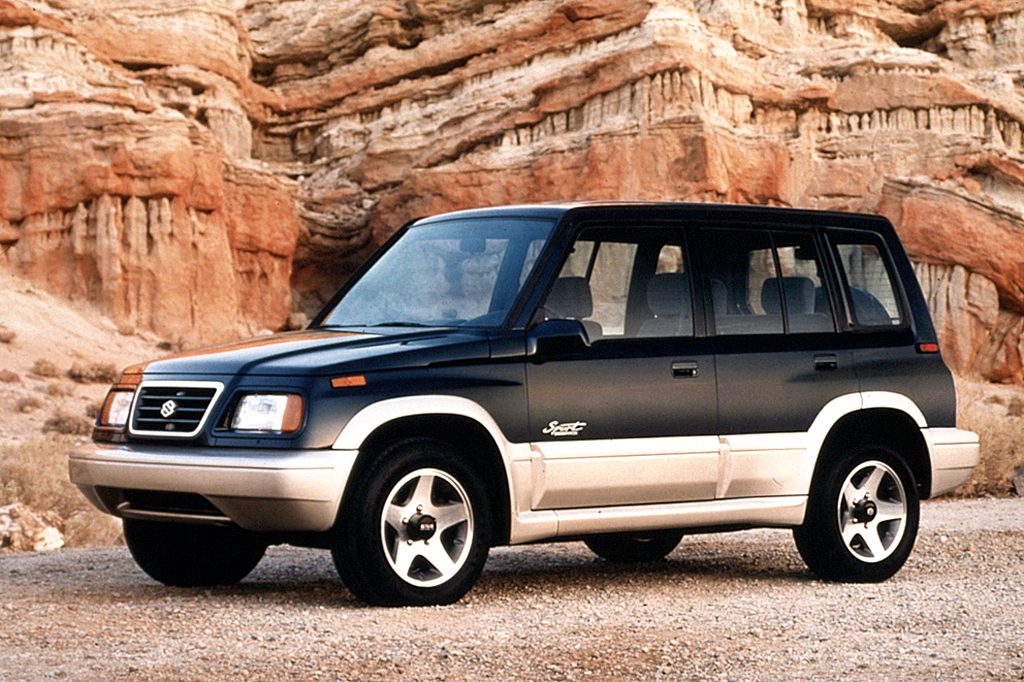
1995 Suzuki Sidekick Sport 4-door wagon
| Pros: |
|
| Cons: |
|
Suzuki launched its compact 4-wheel-drive sport-utility vehicle in 1989, adding a 2-wheel-drive companion for 1990. Geo also sold a version called Tracker. Sidekicks were powered by a 1.6-liter engine that made 80 horsepower. The lineup included a base JS, available only as a soft-top convertible with 2WD; plus more expensive JX and JLX editions, equipped with on-demand 4WD and either a soft top or hardtop. A 5-speed manual transmission was standard, and a 3-speed automatic transmission was optional.
[/vc_column_text][mk_table title=”Yearly Updates” style=”style2″ el_class=”used-yearly-updates”]| 1991 Sidekick A 4-door hardtop Sidekick arrived in ’91, joining the soft-top 2-door models. Riding a wheelbase 11 inches longer than the 2-door’s, bodies measured 16 inches longer overall. Four-door Sidekicks came in base JX and upscale JLX trim. All 4-door models used the 80-horsepower engine with a standard 5-speed manual gearbox, on-demand 4-wheel drive, and new antilock rear brakes. A 2-place folding rear seat was standard on the JLX and optional on the JX. |
| 1992 Sidekick Four-door Sidekicks earned a power boost, adopting a 95-horsepower engine with dual-overhead camshafts. The midlevel JL 4WD convertible was dropped, leaving only two 2-door models, with the 80-horsepower engine. Equipped with 4-wheel drive and new automatic-locking front hubs, 4-door Sidekicks came in JX or top-line JLX trim. A 2-wheel-drive JS 4-door arrived during the 1992 model year. A 4-speed automatic transmission now was installed in 4-door models as an option, but the 3-speed unit hung on for 4WD 2-doors. |
| 1993 Sidekick Except for a few trim changes, Sidekicks showed no appreciable change for 1993. |
| 1994 Sidekick Sidekicks gained an antitheft alarm, tilt steering column, and center high-mounted stoplamp. |
| 1995 Sidekick Two-door JX convertibles got the 95-horsepower engine this year. All two-doors gained a new convertible top with zip-out plastic side windows. |
| 1996 Sidekick Sidekicks added dual airbags in 1996, with 4-wheel antilock braking a new option. The new Sidekick Sport got a more potent engine: a 1.8-liter, making 120 horsepower. All other Sidekicks held the 95-horsepower engine. Offered in JX and JLX trim, Sport models had a longer nose, fender flares, 2-tone paint, 16-inch tires (instead of 14s), and a wider stance. Four-wheel antilock brakes that worked in both 2WD and 4WD joined the option list. |
| 1997 Sidekick A new price-leader 2-wheel-drive JX Sport wagon joined the lineup. Automatic-locking front hubs were standard on the Sport JLX; other models had manual-locking hubs. |
| 1998 Sidekick No changes were made for ’98 in anticipation of an all-new ’99 Sidekick, which would be called the Vitara. |
[/vc_column_text][vc_column_text disable_pattern=”true” align=”left” margin_bottom=”24″ el_class=”used-powertrain-text”]Initial Sidekicks, and all later 2-wheel-drive models, came with an 80-horsepower 1.6-liter 4-cylinder engine. Four-door models got a dual-overhead-cam version in 1992, making 95 horsepower. A 5-speed manual transmission was standard on all models; 3-speed automatic available on 4WD 2-doors, and 4-speed automatic optional on 4-door Sidekicks. A 1.8-liter engine arrived in 1996, for the Sidekick Sport.[/vc_column_text][/vc_column_inner][vc_column_inner width=”1/2″][mk_table style=”style2″ el_class=”used-engine-specs”]
| dohc I4 | ||
| Engine Size (liters/cubic inches) | 1.8/112 | |
| Engine HP | 120 | |
| Engine Torque (lb-ft) | 114 | |
| Avail. Trans. | EPA MPG (city/hwy) | MPG avg. as tested |
| 5-speed manual 4-speed automatic |
23/25 21/24 |
20.2 |
| ohc I4 | ||
| Engine Size (liters/cubic inches) | 1.6/97 | |
| Engine HP | 80 | |
| Engine Torque (lb-ft) | 94 | |
| Avail. Trans. | EPA MPG (city/hwy) | MPG avg. as tested |
| 5-speed manual 3-speed automatic |
25/27 23/24 |
25.3 |
| dohc I4 | ||
| Engine Size (liters/cubic inches) | 1.6/97 | |
| Engine HP | 95 | |
| Engine Torque (lb-ft) | 98 | |
| Avail. Trans. | EPA MPG (city/hwy) | MPG avg. as tested |
| 5-speed manual 4-speed automatic |
23/26 22/26 |
24.8 22.1 |
Acceleration with 80-horsepower engine is on the leisurely side, and the power boost in 1992 does not help much. The Sport model’s larger engine finally offers acceptable performance. That 1.8-liter 4-cylinder works well with the 4-speed automatic transmission. A late-model wagon with manual shift averaged 25.3 mpg, though automatic dropped the figure to a so-so 21.4 mpg. However, even the latest Sidekick engines growl loudly under throttle. Wind and road noise are abundant at highway speeds, too.
Reasonably stable in corners and on the highway, Sidekick suffers a somewhat stiff and jiggly ride on rough surfaces. Four-door models endure less choppiness, credited to their longer wheelbase, but they’re not that much more comfortable overall. Tall and narrow, Sidekicks must be driven with care through turns. Sidekick’s 4-wheel-drive system is not for use on dry pavement.
Head room is plentiful up front, but the rear bench seat holds only two adults, for 4-passenger capacity. Worse yet, it’s hard, with little leg space when the front seats are all the way aft–though space is adequate otherwise. In the Sidekick’s narrow cabin, doors sit close to the seats, leaving little outside shoulder room. Cargo space is best in the 4-door, with its swing-open rear door and fold-down back seat.
[/vc_column_text][/vc_column_inner][vc_column_inner width=”1/2″][mk_content_box icon=”icon-road” heading=”Ratings” el_class=”ratings-box”][vc_column_text disable_pattern=”true” align=”left” margin_bottom=”18″]Model Tested: 1996 Suzuki Sidekick Sport automatic[/vc_column_text][vc_column_text disable_pattern=”true” align=”left” margin_bottom=”18″ el_class=”review-slideshow-caption”]Ratings values are on a 1-10 scale, with 10 being the best. With the exception of Value, these numbers reflect how the vehicle compares against the universe of vehicles, not just against rivals in its class.[/vc_column_text][vc_column_text disable_pattern=”true” align=”left” margin_bottom=”0″ el_class=”used-performance-ratings” title=”Performance”][mk_skill_meter title=”Acceleration – 3″ percent=”30″ color=”#0bb697″][mk_skill_meter title=”Fuel Economy – 4″ percent=”40″ color=”#0bb697″][mk_skill_meter title=”Ride Quality – 2″ percent=”20″ color=”#0bb697″][mk_skill_meter title=”Steering/Handling – 3″ percent=”30″ color=”#0bb697″][mk_skill_meter title=”Quietness – 2″ percent=”20″ color=”#0bb697″][/vc_column_text][vc_column_text disable_pattern=”true” align=”left” margin_bottom=”0″ title=”Accommodations” el_class=”used-accomodations-ratings”][mk_skill_meter title=”Controls/Materials – 3″ percent=”30″ color=”#0bb697″][mk_skill_meter title=”Room/Comfort Front – 4″ percent=”40″ color=”#0bb697″][mk_skill_meter title=”Room/Comfort Rear – 3″ percent=”30″ color=”#0bb697″][mk_skill_meter title=”Cargo Room – 3″ percent=”30″ color=”#0bb697″][/vc_column_text][vc_column_text disable_pattern=”true” align=”left” margin_bottom=”0″ title=”Other” el_class=”used-other-ratings”][mk_skill_meter title=”Value – 3″ percent=”30″ color=”#0bb697″][/vc_column_text][vc_column_text disable_pattern=”true” align=”left” margin_bottom=”0″ el_class=”used-ratings-total”]Total: 30
[/vc_column_text][/mk_content_box][/vc_column_inner][/vc_row_inner][/vc_column][/mk_page_section][mk_page_section attachment=”scroll” bg_position=”left top” bg_repeat=”repeat” bg_stretch=”false” enable_3d=”false” speed_factor=”4″ bg_video=”no” video_mask=”false” video_opacity=”0.6″ top_shadow=”false” section_layout=”full” sidebar=”General” min_height=”100″ padding_top=”10″ padding_bottom=”10″ margin_bottom=”0″ first_page=”false” last_page=”true” section_id=”Specs”][vc_column width=”1/1″][vc_row_inner][vc_column_inner width=”1/2″][vc_column_text title=”Specifications” disable_pattern=”true” align=”left” margin_bottom=”0″][mk_table style=”style2″ el_class=”used-model-specs”]| 2-door convertible | ||||||||||||||||||||||||
| Wheelbase (in.) | Length (in.) | Width (in.) | Height (in.) | Weight (lbs) | ||||||||||||||||||||
| 86.6 | 143.7 | 64.2 | 64.3 | |||||||||||||||||||||
|
||||||||||||||||||||||||
| 4-door wagon | ||||||||||||||||||||||||
| Wheelbase (in.) | Length (in.) | Width (in.) | Height (in.) | Weight (lbs) | ||||||||||||||||||||
| 97.6 | 158.7 | 64.4 | 65.7 | |||||||||||||||||||||
|
||||||||||||||||||||||||
| 4-door wagon | ||||||||||||||||||||||||
| Wheelbase (in.) | Length (in.) | Width (in.) | Height (in.) | Weight (lbs) | ||||||||||||||||||||
| 97.6 | 162.4 | 66.7 | 66.3 | |||||||||||||||||||||
|
||||||||||||||||||||||||
Front Impact Test
[mk_skill_meter title=”Driver Injury – 2″ percent=”40″ color=”#0bb697″][mk_skill_meter title=”Front Passenger Injury – 3″ percent=”60″ color=”#0bb697″]Side Impact Test
[mk_skill_meter title=”Driver Injury – N/A” percent=”N/A0″ color=”#0bb697″][mk_skill_meter title=”Rear Passenger Injury – N/A” percent=”N/A0″ color=”#0bb697″][/vc_column_text][vc_column_text title=”HLDI” disable_pattern=”true” align=”left” margin_bottom=”0″ el_class=”used-hldi-ratings-head”] [/vc_column_text][mk_table style=”style2″ el_class=”used-hldi-ratings”]| Collision | 108 |
| Injury | 129 |
| Theft | 99 |
| Automatic transmission Description: The transfer case binds and can be damaged if driven on dry roads in 4WD mode. (1990-97) |
| Automatic transmission Description: The automatic transmission may hunt between 40-45 mph. A time-delay module kit for the torque-converter clutch should correct the condition. (1990-95) |
| Engine misfire Description: Using premium fuel can trigger trouble codes and cause poor starting. (1996-97) |
| Engine misfire Description: Throttle position sensor problems became frequent enough that the company made the sensor available as a spare part. (1990-99) |
| Hard starting Description: Hard starting below freezing, especially at high altitudes, requires a Cold Start Harness Set. (1990) |
| Vehicle noise Description: Body-mount bushing sleeves contacting body cause clunking noises from the front of vehicle. (1991-98) |
| 1990-91 Description: Front-seatbelt button can break and pieces can fall inside. |
| 1993 Description: The right rear and left axle-shaft housing tubes were improperly welded and can fracture, resulting in separation of the wheel assembly which could impede vehicle control and/or increase stopping distance. |
| 1996 4-doors Description: Fuel tank can puncture during rear-end collision. |
| 1996-97 Description: Mounting bolts that attach upper end of front struts to vehicle body could break, causing loss of control. |