
| Compact pickup truck; Built in USA |
|
|
| Good condition price range: $1,000 – $2,900* |
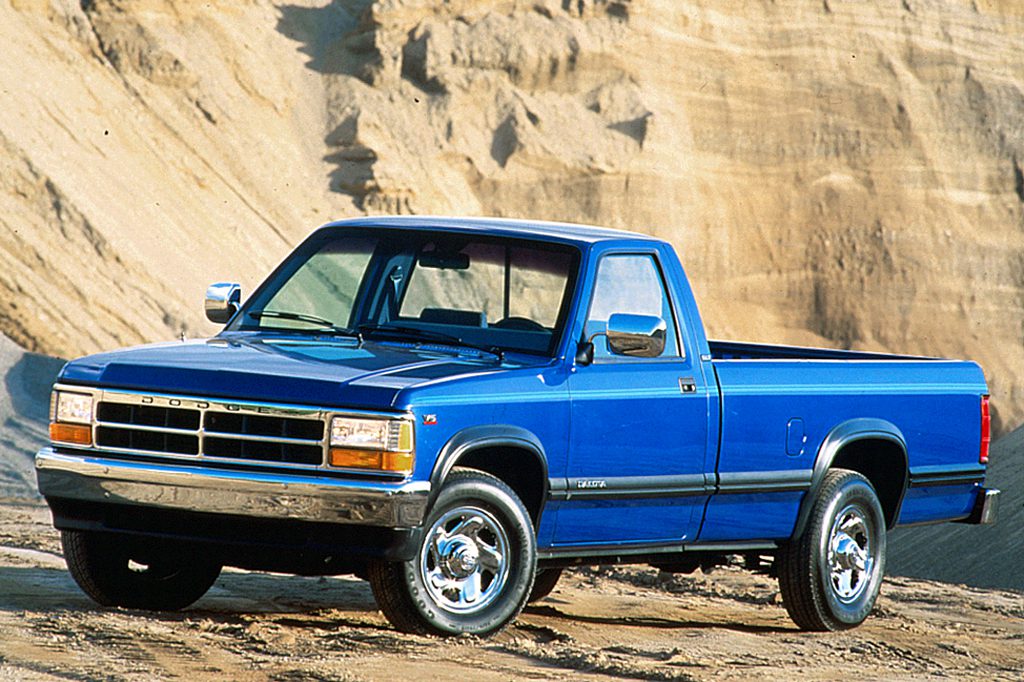
1994 Dodge Dakota Sport 4WD regular cab
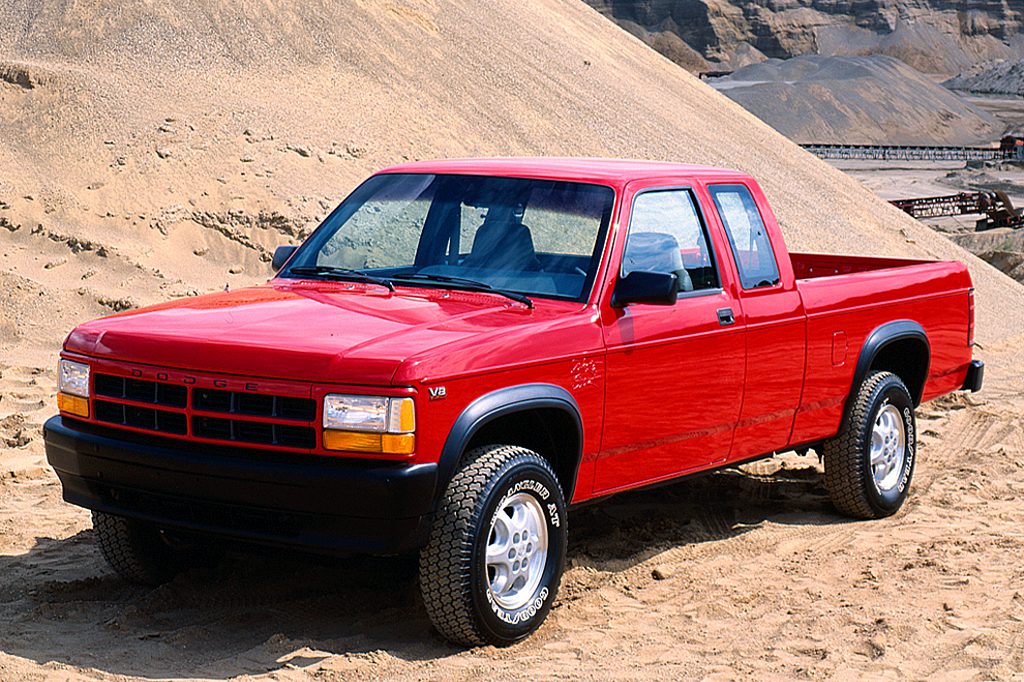
1994 Dodge Dakota Sport 4WD Club Cab extended cab
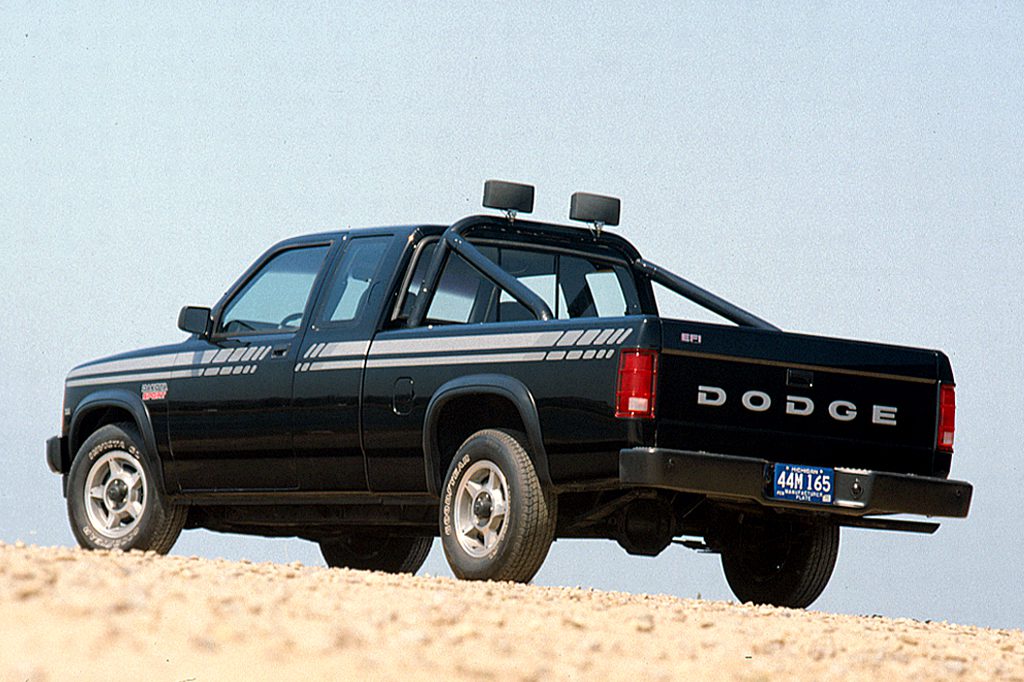
1990 Dodge Dakota Club Cab extended cab
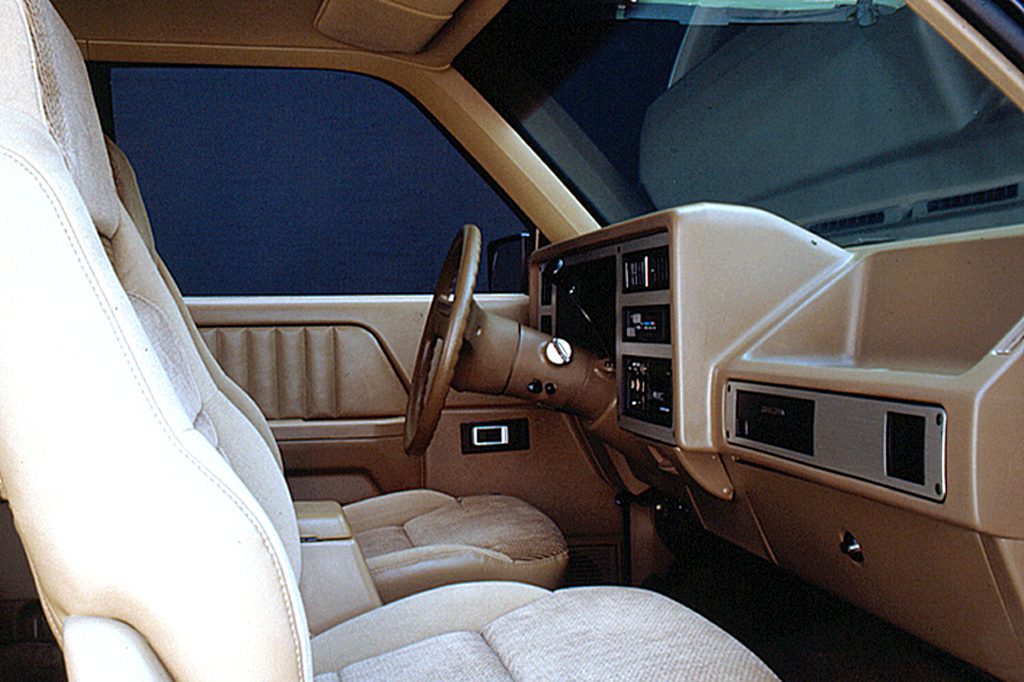
1990 Dodge Dakota interior
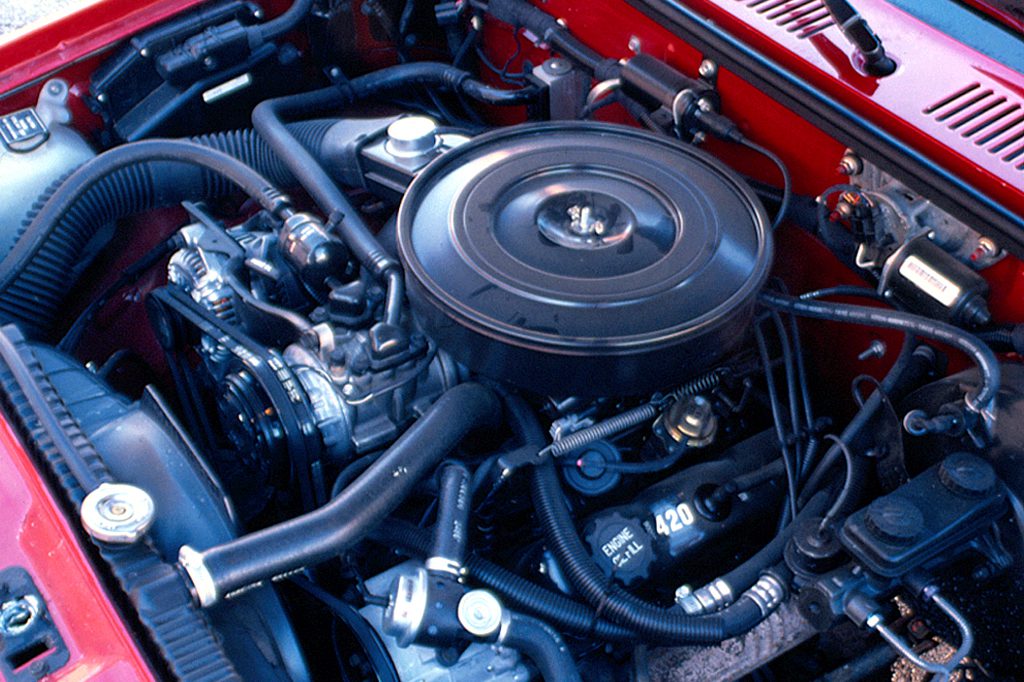
1990 Dodge Dakota engine
| Pros: |
|
| Cons: |
|
Introduced for 1987, Dodge’s Dakota was the first midsize pickup–larger than most compacts and smaller than full-size models. Dakotas came in two sizes: 112-inch wheelbase with a 6.5-foot cargo bed, or 124-inch wheelbase with an 8-foot bed. Each had a 3-place bench seat, but bucket seats might be installed in base or Sport models. A Club Cab pickup arrived in 1990, with a 131-inch wheelbase and 6.5-foot bed, plus storage compartments beneath hinged rear cushions. Rear antilock brakes had been added for 1989. An innovative convertible pickup truck joined the line during 1989, with standard 3.9-liter V6, but remained on sale only into 1990.
[/vc_column_text][mk_table title=”Yearly Updates” style=”style2″ el_class=”used-yearly-updates”]| 1991 Dakota A V8 engine become available this year–the only such installation offered in a non-full-size pickup. In addition, the 4-cylinder base engine gained 17 horsepower. All Dakotas got a freshened front end, including a new grille and bumper. Nose sheetmetal was extended about three inches. LE and Sport models gained aero headlamps, while the Sport got a body-color grille and front air dam with fog lamps (plus a chrome roof bar with off-road lights). Club Cab trucks could now have 4-wheel drive. |
| 1992 Dakota Both V6 and V8 engines gained a whopping power boost. Horsepower jumped from 125 to 180 on the V6 and 165 to 230 on the V8. |
| 1993 Dakota Four-wheel antilock braking became available (a “first” for pickups of any brand). Dakotas got a stainless steel exhaust, seat cushions were recontoured, and 4-cylinder engines lost power. |
| 1994 Dakota Safety got the nod this season. Dakota became the first pickup with a driver-side airbag, accompanied by a new padded knee bolster, side door guard beams, and center high-mounted stoplamp. |
| 1995 Dakota A shift interlock was added to manual transmissions, and a 2WD Sport Club Cab model joined the 1995 lineup. |
| 1996 Dakota A new “Magnum” 4-cylinder base engine went into Dakotas for their final outing in this form. Automatic transmissions gained electronic shift controls. |
[/vc_column_text][vc_column_text disable_pattern=”true” align=”left” margin_bottom=”24″ el_class=”used-powertrain-text”]Two- and 4-wheel-drive Dakotas had a 100-horsepower, 2.5-liter 4-cylinder engine, or a 3.9-liter V6 that made 125 horsepower. The V6 was standard in 4×4 and Sport models, optional in 2WDs, except for the price-leader Dakota S. A 5-speed manual gearbox was standard and 4-speed automatic optional. Dakota’s 4WD setup is a part-time, on-demand system, not intended for use on dry pavement. It used automatic-locking front hubs and a floor-mounted transfer-case lever.[/vc_column_text][/vc_column_inner][vc_column_inner width=”1/2″][mk_table style=”style2″ el_class=”used-engine-specs”]
| ohc V6 | ||
| Engine Size (liters/cubic inches) | 3.9/239 | |
| Engine HP | 125-180 | |
| Engine Torque (lb-ft) | 195-225 | |
| Avail. Trans. | EPA MPG (city/hwy) | MPG avg. as tested |
| 5-speed manual 4-speed automatic |
16/22 16/20 |
|
| ohv V8 | ||
| Engine Size (liters/cubic inches) | 5.2/318 | |
| Engine HP | 165-230 | |
| Engine Torque (lb-ft) | 250-295 | |
| Avail. Trans. | EPA MPG (city/hwy) | MPG avg. as tested |
| 5-speed manual 4-speed automatic |
14/20 14/18 |
15.4 13.9 |
| ohc I4 | ||
| Engine Size (liters/cubic inches) | 2.5/153 | |
| Engine HP | 99-120 | |
| Engine Torque (lb-ft) | 132-145 | |
| Avail. Trans. | EPA MPG (city/hwy) | MPG avg. as tested |
| 5-speed manual | 21/25 | 20.2 |
Regular cabs have ample space for three adults, but neither the bench seat nor the available buckets are particularly comfortable (1993 and later buckets are better). Not much storage space is available behind the seat, unless you opt for the Club Cab. But it’s hard to get into the rear seat, which isn’t sufficient for three and has limited knee room. The floor-mounted 4WD lever is low and sits well forward, so you have to reach under the dash to shift from 2WD to 4WD High. Other controls are easy to reach.
The base 4-cylinder engine is adequate, but not a wise choice unless you rarely carry cargo. Relaxed at highway speeds, the husky early V6 develops enough low-speed torque to haul heavy loads, but it’s still no fireball when pushing hard. The “Magnum” V6 introduced for 1992 yields better acceleration (Dodge claimed a 0-60 mph time of 8.3 seconds), but engine and exhaust noise are more noticeable under hard throttle. Acceleration is more robust yet with the V8, which is the choice for towing. Dakotas handle competently and ride well considering their size, though the ride gets bouncy when the cargo box is empty. Despite ABS, rear wheels tend to lock prematurely in hard stops. We’d prefer a later model with the optional 4-wheel antilock braking.
[/vc_column_text][/vc_column_inner][vc_column_inner width=”1/2″][mk_content_box icon=”icon-road” heading=”Ratings” el_class=”ratings-box”][vc_column_text disable_pattern=”true” align=”left” margin_bottom=”18″]Model Tested: 1994 Dodge Dakota 3.9-liter ext. cab[/vc_column_text][vc_column_text disable_pattern=”true” align=”left” margin_bottom=”18″ el_class=”review-slideshow-caption”]Ratings values are on a 1-10 scale, with 10 being the best. With the exception of Value, these numbers reflect how the vehicle compares against the universe of vehicles, not just against rivals in its class.[/vc_column_text][vc_column_text disable_pattern=”true” align=”left” margin_bottom=”0″ el_class=”used-performance-ratings” title=”Performance”][mk_skill_meter title=”Acceleration – 4″ percent=”40″ color=”#0bb697″][mk_skill_meter title=”Fuel Economy – 3″ percent=”30″ color=”#0bb697″][mk_skill_meter title=”Ride Quality – 3″ percent=”30″ color=”#0bb697″][mk_skill_meter title=”Steering/Handling – 3″ percent=”30″ color=”#0bb697″][mk_skill_meter title=”Quietness – 3″ percent=”30″ color=”#0bb697″][/vc_column_text][vc_column_text disable_pattern=”true” align=”left” margin_bottom=”0″ title=”Accommodations” el_class=”used-accomodations-ratings”][mk_skill_meter title=”Controls/Materials – 3″ percent=”30″ color=”#0bb697″][mk_skill_meter title=”Room/Comfort Front – 5″ percent=”50″ color=”#0bb697″][mk_skill_meter title=”Room/Comfort Rear – 1″ percent=”10″ color=”#0bb697″][mk_skill_meter title=”Cargo Room – 2″ percent=”20″ color=”#0bb697″][/vc_column_text][vc_column_text disable_pattern=”true” align=”left” margin_bottom=”0″ title=”Other” el_class=”used-other-ratings”][mk_skill_meter title=”Value – 4″ percent=”40″ color=”#0bb697″][/vc_column_text][vc_column_text disable_pattern=”true” align=”left” margin_bottom=”0″ el_class=”used-ratings-total”]Total: 31
[/vc_column_text][/mk_content_box][/vc_column_inner][/vc_row_inner][/vc_column][/mk_page_section][mk_page_section attachment=”scroll” bg_position=”left top” bg_repeat=”repeat” bg_stretch=”false” enable_3d=”false” speed_factor=”4″ bg_video=”no” video_mask=”false” video_opacity=”0.6″ top_shadow=”false” section_layout=”full” sidebar=”General” min_height=”100″ padding_top=”10″ padding_bottom=”10″ margin_bottom=”0″ first_page=”false” last_page=”true” section_id=”Specs”][vc_column width=”1/1″][vc_row_inner][vc_column_inner width=”1/2″][vc_column_text title=”Specifications” disable_pattern=”true” align=”left” margin_bottom=”0″][mk_table style=”style2″ el_class=”used-model-specs”]| ext. cab | ||||||||||||||||||||||||
| Wheelbase (in.) | Length (in.) | Width (in.) | Height (in.) | Weight (lbs) | ||||||||||||||||||||
| 130.9 | 208.0 | 69.4 | 65.6 | |||||||||||||||||||||
|
||||||||||||||||||||||||
| reg. cab long bed | ||||||||||||||||||||||||
| Wheelbase (in.) | Length (in.) | Width (in.) | Height (in.) | Weight (lbs) | ||||||||||||||||||||
| 123.9 | 207.5 | 69.4 | 65.0 | |||||||||||||||||||||
|
||||||||||||||||||||||||
| reg. cab short bed | ||||||||||||||||||||||||
| Wheelbase (in.) | Length (in.) | Width (in.) | Height (in.) | Weight (lbs) | ||||||||||||||||||||
| 111.9 | 189.0 | 69.4 | 65.0 | |||||||||||||||||||||
|
||||||||||||||||||||||||
Front Impact Test
[mk_skill_meter title=”Driver Injury – 5″ percent=”100″ color=”#0bb697″][mk_skill_meter title=”Front Passenger Injury – 4″ percent=”80″ color=”#0bb697″]Side Impact Test
[mk_skill_meter title=”Driver Injury – N/A” percent=”N/A0″ color=”#0bb697″][mk_skill_meter title=”Rear Passenger Injury – N/A” percent=”N/A0″ color=”#0bb697″][/vc_column_text][vc_column_text title=”HLDI” disable_pattern=”true” align=”left” margin_bottom=”0″ el_class=”used-hldi-ratings-head”] [/vc_column_text][mk_table style=”style2″ el_class=”used-hldi-ratings”]| Collision | 83 |
| Injury | 60 |
| Theft | N/A |
| Air conditioner Description: If the air conditioner gradually stops cooling and/or the airflow from the vents decreases, the computer (PCM) may not be sending a signal to the compressor clutch relay to cycle off, which causes the AC evaporator to freeze up. (1991-95) |
| Automatic transmission Description: If the transmission will not engage when first started, chances are the torque converter is draining down. Chrysler will correct the problem by installing a check valve. (1993) |
| Automatic transmission Description: If the transmission won’t upshift in cool weather, it is probably due to defective cast iron seal rings in the governor drive. (1992-94) |
| Engine fan noise Description: In warm weather, the fan makes a roaring sound. Dodge will replace the fan, the fan clutch, and, on max cooling systems, the radiator cap. (All) |
| Exhaust backfire Description: Exhaust backfire and/or a popping noise in the exhaust may be caused by a defective Powertrain Control Module. (1994-95) |
| Oil leak Description: Rear main seals on 2.5- and 4.0-liter engines are prone to leakage. To prevent future failures, Chrysler has a rubber plug available that goes in a hole above the starter that protects the rear main seal. (1996) |
| Oil leak Description: Oil leak at the filter on 3.9-, 5.2-, and 5.9-liter engines is likely due to a warped adapter plate. (1995) |
| Oil pump Description: Oil pump gear wear results in bucking and surging when the engine is warm and lack of lubrication when the engine is cold. (1992-93) |
| Rough idle Description: Because of a problem with the idle air control motor, the engine idles rough, stalls at low speeds or when decelerating, especially in warm weather. (1992-94) |
| Suspension noise Description: Front ball joints wear prematurely forcing relacement of lower control arm as well. Replacement joint with grease fitting is now available. (1990-96) |
| Transaxle leak Description: Automatic transmission fluid leaks from the speed sensor in the transmission. (1994) |
| Water leak Description: The roof seams leak water that seeps down behind the dashboard onto the floor. (1993-95) |
| 1990 Description: Valve cover gasket may allow oil leakage. |
| 1990 light-duty 4×2 and club-cab w/V8 Description: Frame can crack at steering-gear attachment and/or mounting bolts can fracture, allowing steering gear to separate. |
| 1991 w/4-speed automatic Description: Fuel hose may contact wiring harness, resulting in leakage. |
| 1991 Description: Premium steering wheel could crack and separate from hub. |
| 1991 2WD Description: Right front-brake hose may rub against tire during full-left turn. |
| 1991-92 w/A500 automatic transmission Description: Inadvertent placement of shift lever in “Reverse” can occur when driver believes it has been placed in “Park.” |
| 1993 Description: ABS could become inoperative when hard pedal effort is applied. |
| 1994 Description: Fuel-tank support straps could separate resulting in fuel leak and increased risk of fire. |
| 1994 Description: Control-arm attaching bolts were not properly heat treated. If they break, steering control could be lost. |
| 1994 Description: Dealers will install a redesigned steering-wheel back cover to keep extra keys from getting caught behind the wheel when the key is in the ignition. |
| 1996 w/2.5-liter engine Description: Power-brake-vacuum hose in some trucks could be improperly installed; disconnected hose can cause increase in idle speed and loss of power assist. |