
| Premium midsize car; Built in USA |
|
|
| Good condition price range: $1,400 – $3,200* |
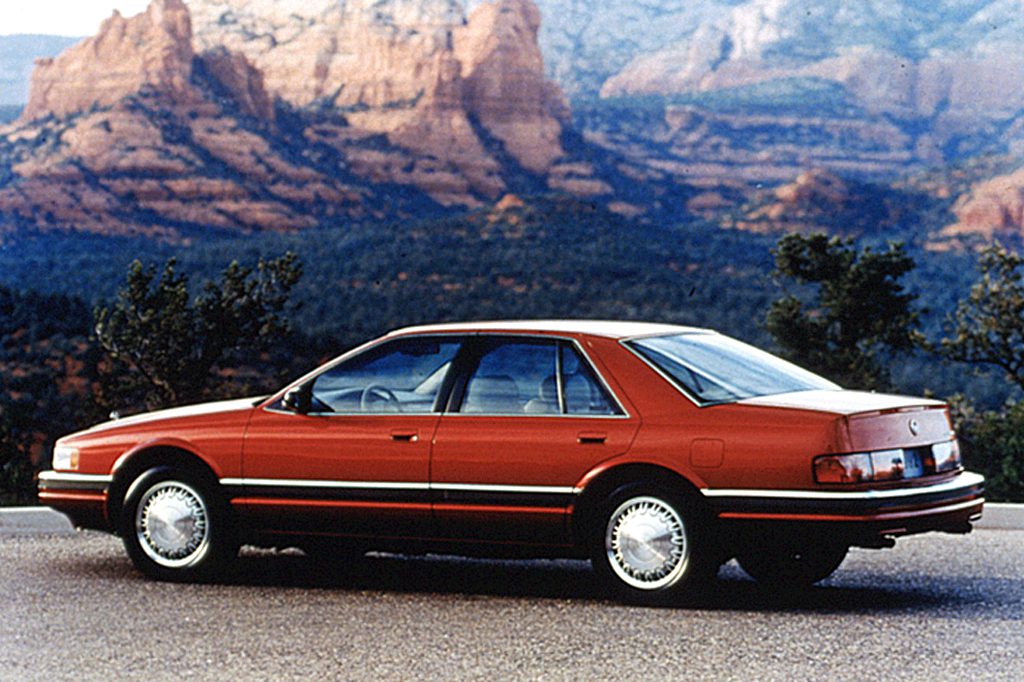
1992 Cadillac Seville
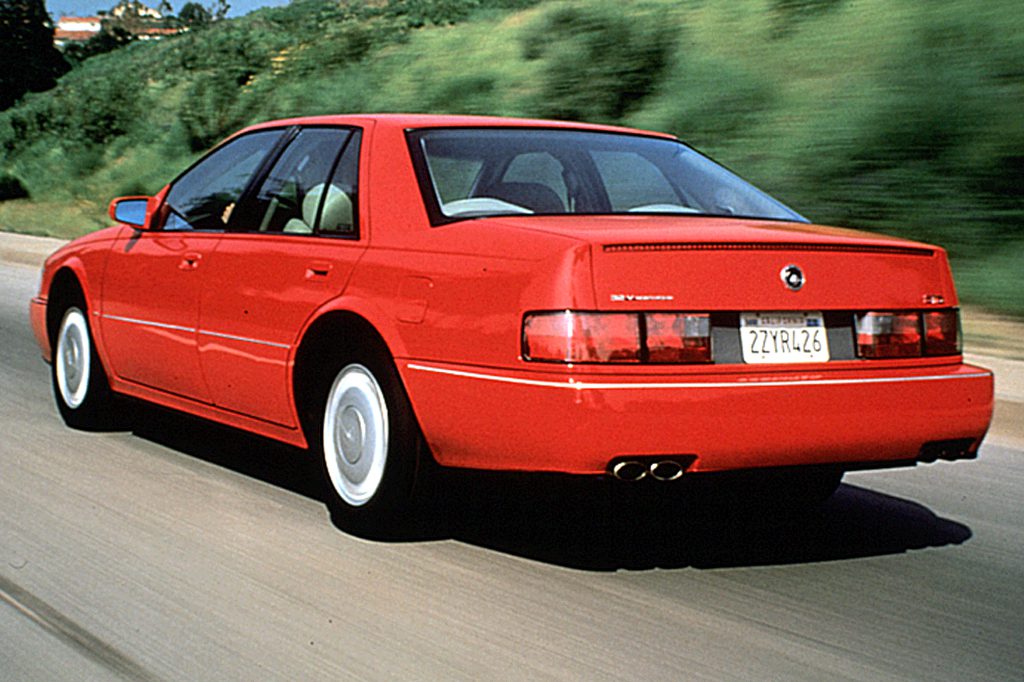
1993 Cadillac Seville STS
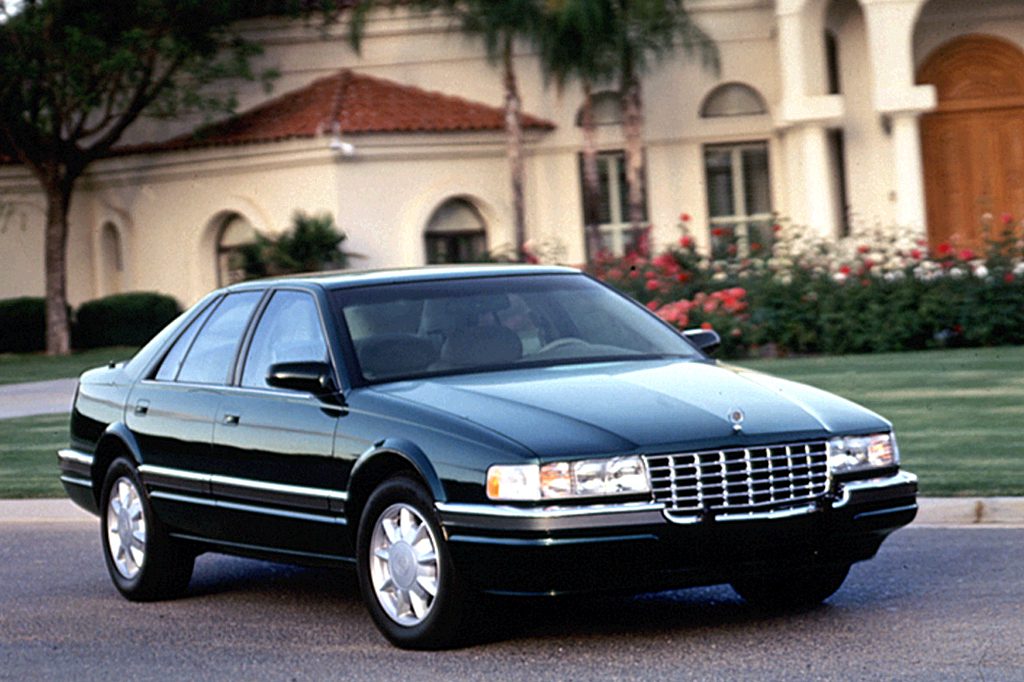
1996 Cadillac Seville
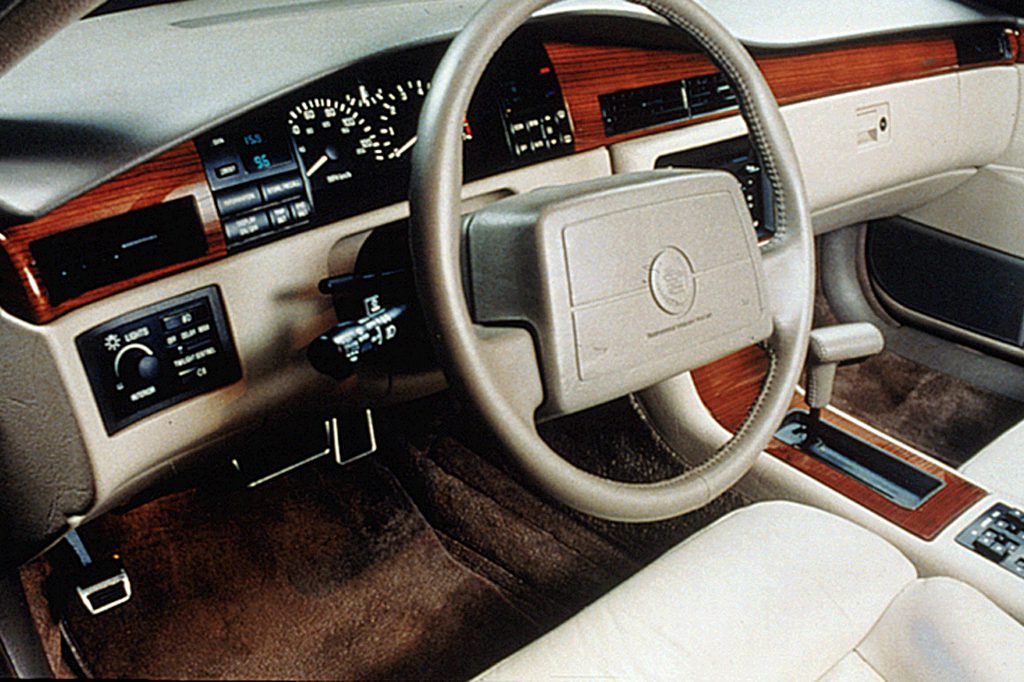
1992 Cadillac Seville STS interior
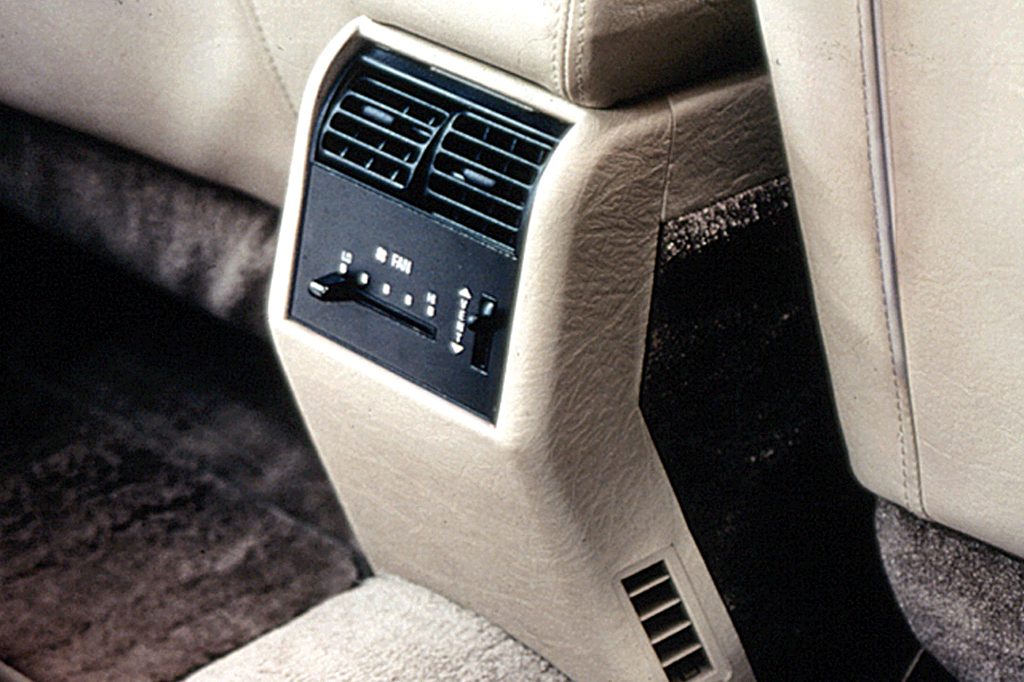
1992 Cadillac Seville STS interior
| Pros: |
|
| Cons: |
|
Though riding the same platform as the Eldorado coupe, Seville’s ’92 redesign showed radically different styling. On a 111-inch wheelbase, Seville sedans measured a foot longer than before, which translated to extra leg room inside–3.5 inches. Width grew as well. Antilock braking and a driver’s airbag were standard. A sport interior option included analog gauges to replace the customary digital units, along with a console-mounted gearshift–which otherwise sat on the steering column. Hottest member of the line was the STS (Seville Touring Sedan), flaunting monochromatic body paint, quicker steering, and thicker stabilizer bars. Each STS held analog gauges and leather seating surfaces (optional on base Sevilles).
[/vc_column_text][mk_table title=”Yearly Updates” style=”style2″ el_class=”used-yearly-updates”]| 1993 Seville Dual airbags went into ’93 Sevilles. So did a brand-new Northstar V8 engine. Standard in the STS, the 4.6-liter dual-cam Northstar developed 295 horsepower. This year’s 4-speed automatic transmission adopted electronic controls. A new STS traction-control system applied brakes and reduced engine power to deliver top tire grip on slippery surfaces. STS sedans also gained a new Road Sensing Suspension, which used a computer to “read” the road surface, then adjust firmness. Base Sevilles added Speed Sensitive Suspension, which alters suspension settings according to speed. |
| 1994 Seville Both models carried Northstar engines in ’94. The 270-horsepower V8 of 1993 now served as base engine for the Seville Luxury Sedan (SLS), while the STS kept its 295-horsepower version. All Sevilles had traction control and a Road Sensing Suspension. |
| 1995 Seville Engines added a little power, and an Integrated Chassis Control System arrived to improve braking, handling, and traction control. Headlights turned on automatically with the wipers. |
| 1996 Seville Sevilles got daytime running lights and a new dashboard with larger analog gauges, plus climate and stereo controls grouped in the center. Radios added redundant controls in the steering wheel, where climate controls also could be found. |
| 1997 Seville The addition of new high-tech systems were the primary changes for 1997. New features added to the STS included Cadillac’s Stabilitrack emergency-traction system and Rainsense automatic wipers. Seville was redesigned for 1998. |
[/vc_column_text][vc_column_text disable_pattern=”true” align=”left” margin_bottom=”24″ el_class=”used-powertrain-text”]For the 1992 season, a 4.9-liter 200-horsepower V8 fed an electronically controlled 4-speed automatic transmission. A year later, the 32-valve dual-cam, 4.6-liter Northstar V8 debuted, delivering 295 horsepower when installed in the Seville Touring Sedan (STS). For 1994, a less-potent (270-horsepower) Northstar rendition became the base engine. Both engines gained five horsepower for ’95, and the STS version added five pound-feet of torque.[/vc_column_text][/vc_column_inner][vc_column_inner width=”1/2″][mk_table style=”style2″ el_class=”used-engine-specs”]
| ohv V8 | ||
| Engine Size (liters/cubic inches) | 4.9/300 | |
| Engine HP | 200 | |
| Engine Torque (lb-ft) | 275 | |
| Avail. Trans. | EPA MPG (city/hwy) | MPG avg. as tested |
| 4-speed automatic | 16/25 | |
| dohc V8 | ||
| Engine Size (liters/cubic inches) | 4.6/279 | |
| Engine HP | 270-275 | |
| Engine Torque (lb-ft) | 300 | |
| Avail. Trans. | EPA MPG (city/hwy) | MPG avg. as tested |
| 4-speed automatic | 17/26 | 15.9 |
| dohc V8 | ||
| Engine Size (liters/cubic inches) | 4.6/279 | |
| Engine HP | 295-300 | |
| Engine Torque (lb-ft) | 290-295 | |
| Avail. Trans. | EPA MPG (city/hwy) | MPG avg. as tested |
| 4-speed automatic | 17/26 | 16.8 |
More than prior Sevilles, the 1992-96 edition displays fine road manners and a rock-solid feel, thanks to a stiffened chassis. Road noise was reduced, and improved engine-mounting better isolated the V8 from the passenger compartment. Despite the extra bulk, acceleration is brisk with the initial 4.9-liter engine, never lacking for strength whether in the city or on the highway. Shifts are almost imperceptible. The Northstar V8 added for 1993 is smoother and faster yet, but limits its most impressive acceleration to engine speeds above 3500 rpm. That gives the STS terrific performance on the open road.
Speed-dependent Computer Command Ride adds to the secure feel of early Sevilles. Sure, the base-model ride is a bit soft at lower speeds (under 45 mph or so), but the bounce is nearly gone at highway velocities, and the sedan cruises with commendable stability and comfort. At low speeds, the 1993-up STS’s Road Sensing Suspension floats less than the base setup. It’s also more absorbent at higher speeds, and handles better on bumpy pavement. Steering is firm and precise, and the sedan remains stable through corners. Stiff tires give the later STS impressive handling, but a harsh, even jittery ride. Softer tires on the base (SLS) sedan transmit less impact and generate less noise. The ’96 STS adopted softer tires, reducing the contrast between models.
Head room is ample, front and rear. Adult knees aren’t likely to press into the front seatback. Wide rear doors make entry/exit a snap, but thick roof pillars hamper over-the-shoulder visibility. Dashboards are well laid out, but climate-control buttons are hidden to the right of the steering wheel. That flaw was corrected in the 1996 STS, but the SLS kept the prior layout. The roomy trunk has a flat floor that’s wide at the rear and stretches well forward. Its lid opens nearly from bumper height for easy loading.
[/vc_column_text][/vc_column_inner][vc_column_inner width=”1/2″][mk_content_box icon=”icon-road” heading=”Ratings” el_class=”ratings-box”][vc_column_text disable_pattern=”true” align=”left” margin_bottom=”18″]Model Tested: 1995 Cadillac Seville SLS[/vc_column_text][vc_column_text disable_pattern=”true” align=”left” margin_bottom=”18″ el_class=”review-slideshow-caption”]Ratings values are on a 1-10 scale, with 10 being the best. With the exception of Value, these numbers reflect how the vehicle compares against the universe of vehicles, not just against rivals in its class.[/vc_column_text][vc_column_text disable_pattern=”true” align=”left” margin_bottom=”0″ el_class=”used-performance-ratings” title=”Performance”][mk_skill_meter title=”Acceleration – 8″ percent=”80″ color=”#0bb697″][mk_skill_meter title=”Fuel Economy – 2″ percent=”20″ color=”#0bb697″][mk_skill_meter title=”Ride Quality – 7″ percent=”70″ color=”#0bb697″][mk_skill_meter title=”Steering/Handling – 6″ percent=”60″ color=”#0bb697″][mk_skill_meter title=”Quietness – 7″ percent=”70″ color=”#0bb697″][/vc_column_text][vc_column_text disable_pattern=”true” align=”left” margin_bottom=”0″ title=”Accommodations” el_class=”used-accomodations-ratings”][mk_skill_meter title=”Controls/Materials – 7″ percent=”70″ color=”#0bb697″][mk_skill_meter title=”Room/Comfort Front – 8″ percent=”80″ color=”#0bb697″][mk_skill_meter title=”Room/Comfort Rear – 4″ percent=”40″ color=”#0bb697″][mk_skill_meter title=”Cargo Room – 4″ percent=”40″ color=”#0bb697″][/vc_column_text][vc_column_text disable_pattern=”true” align=”left” margin_bottom=”0″ title=”Other” el_class=”used-other-ratings”][mk_skill_meter title=”Value – 7″ percent=”70″ color=”#0bb697″][/vc_column_text][vc_column_text disable_pattern=”true” align=”left” margin_bottom=”0″ el_class=”used-ratings-total”]Total: 60
[/vc_column_text][/mk_content_box][/vc_column_inner][/vc_row_inner][/vc_column][/mk_page_section][mk_page_section attachment=”scroll” bg_position=”left top” bg_repeat=”repeat” bg_stretch=”false” enable_3d=”false” speed_factor=”4″ bg_video=”no” video_mask=”false” video_opacity=”0.6″ top_shadow=”false” section_layout=”full” sidebar=”General” min_height=”100″ padding_top=”10″ padding_bottom=”10″ margin_bottom=”0″ first_page=”false” last_page=”true” section_id=”Specs”][vc_column width=”1/1″][vc_row_inner][vc_column_inner width=”1/2″][vc_column_text title=”Specifications” disable_pattern=”true” align=”left” margin_bottom=”0″][mk_table style=”style2″ el_class=”used-model-specs”]| 4-door sedan | ||||||||||||||||||||||||
| Wheelbase (in.) | Length (in.) | Width (in.) | Height (in.) | Weight (lbs) | ||||||||||||||||||||
| 111.0 | 204.1 | 74.2 | 54.5 | |||||||||||||||||||||
|
||||||||||||||||||||||||
Front Impact Test
[mk_skill_meter title=”Driver Injury – N/A” percent=”N/A0″ color=”#0bb697″][mk_skill_meter title=”Front Passenger Injury – N/A” percent=”N/A0″ color=”#0bb697″]Side Impact Test
[mk_skill_meter title=”Driver Injury – N/A” percent=”N/A0″ color=”#0bb697″][mk_skill_meter title=”Rear Passenger Injury – N/A” percent=”N/A0″ color=”#0bb697″][/vc_column_text][vc_column_text title=”HLDI” disable_pattern=”true” align=”left” margin_bottom=”0″ el_class=”used-hldi-ratings-head”] [/vc_column_text][mk_table style=”style2″ el_class=”used-hldi-ratings”]| Collision | 107 |
| Injury | 50 |
| Theft | 73 |
| Automatic transmission Description: 4T60E transmissions may drop out of drive while cruising, shift erratically, or have no second, third, or fourth gear because of a bad ground connection for the shift solenoids. Poor grounds also allow wrong gear starts. (1991-93) |
| Dashboard lights Description: Wiring problem could cause “Traction Engaged” light to illuminate. (1997) |
| Engine noise Description: A rattling noise at startup is often caused by automatic-transmission pump starvation or cavitation, or a sticking pressure-regulator valve. (1992-93) |
| Steering noise Description: The upper bearing mount in the steering column can get loose and cause a snapping or clicking, requiring a new bearing spring and turn-signal cancel cam. (1994-96) |
| Transaxle leak Description: The right front axle seal at the automatic transaxle is prone to leak and GM issued a revised seal to correct the problem. (1992-93) |
| Transaxle leak Description: 440-T4 automatic transmissions may shift late or not upshift at all. The problem is a stuck throttle valve inside the transmission. (1992) |
| 1992 Description: Intermediate shaft to steering rack lower-coupling pinch bolt may be missing on some cars; disengagement of shaft produces loss of steering control. |
| 1993 w/4.6-liter V8 Description: Fuel feed and return lines to fuel injection system could work loose, causing fuel leakage in engine compartment. |
| 1993-94 w/4.6-liter V8 Description: If air-conditioner compressor-clutch assembly contacts auxiliary engine-oil-cooler outlet hose, the hose may wear through. |
| 1994 Description: Throttle cable can disengage and interfere with cam mechanism; car could accelerate unexpectedly. |
| 1995 Description: Airbag could deploy inadvertently, due to water intrusion. |
| 1995-97 Description: The fuel line tubing on certain vehicles may crack causing fuel leakage. Dealers will inspect and replace affected parts. |
| 1996 Description: Analog instrument cluster on some cars could have internal short circuit disrupting Pass-Key system, causing failure of gauges and most telltale indicators, and possible no-start condition; panel could go black while driving. |
| 1997 Description: Brake/traction-control module can cause antilock system to cycle in non-ABS braking; could increase stopping distance. |