
| Large car; Built in USA |
|
|
| Good condition price range: $1,100 – $3,300* |
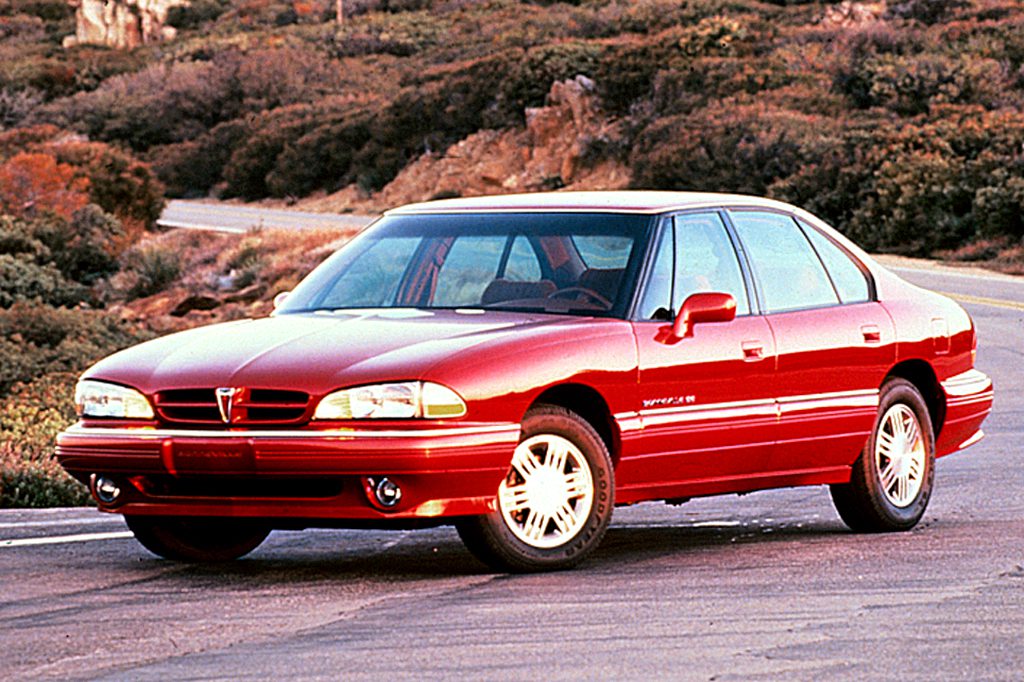
1992 Pontiac Bonneville SE
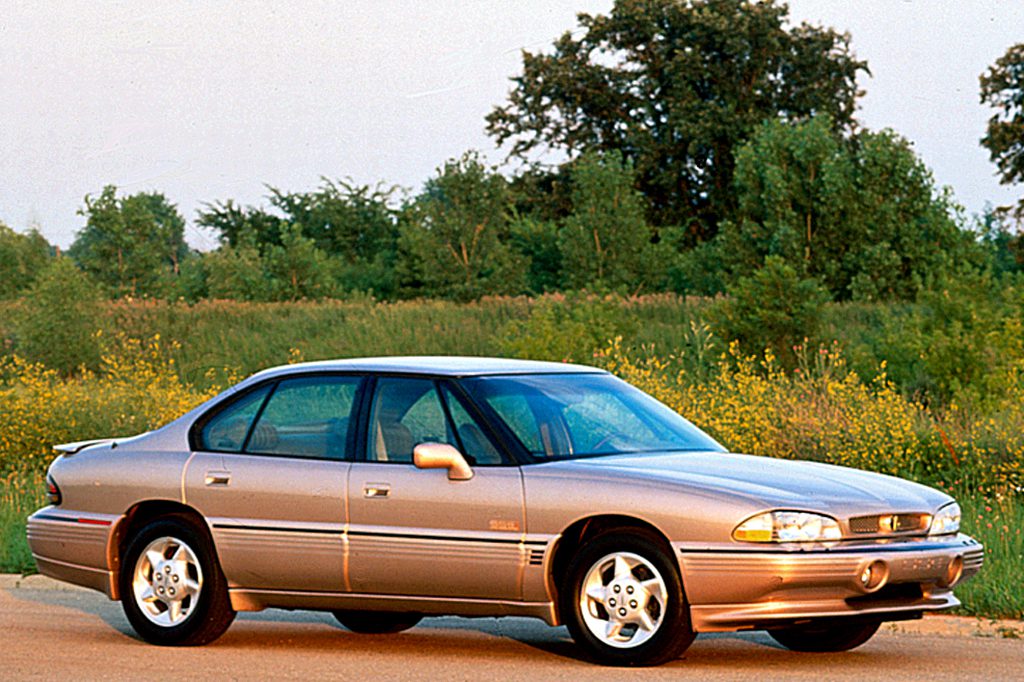
1992 Pontiac Bonneville
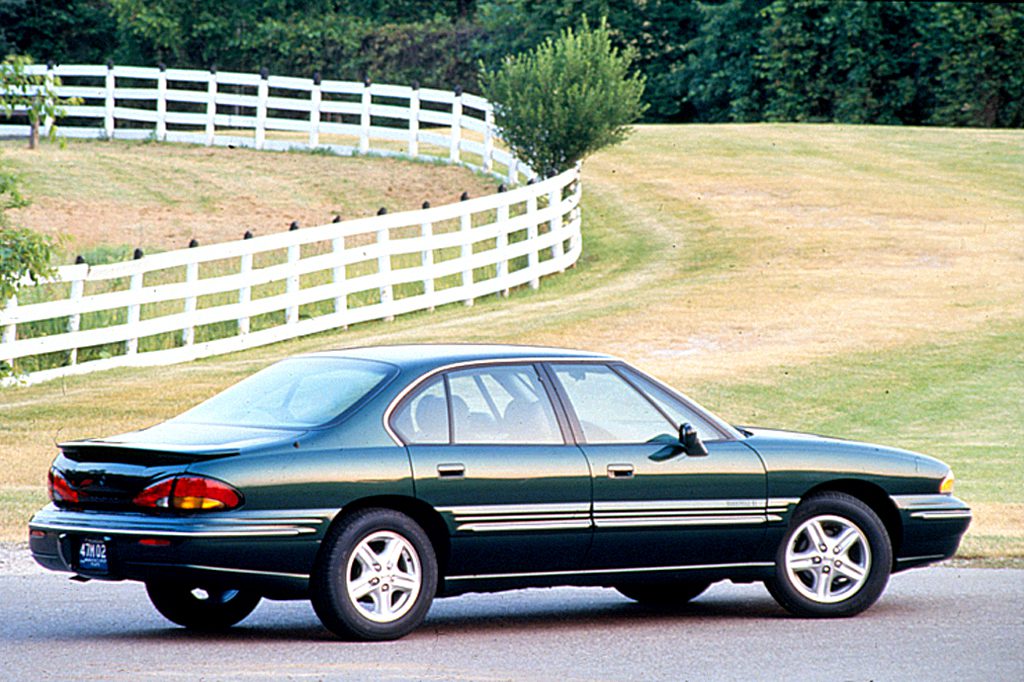
1996 Pontiac Bonneville
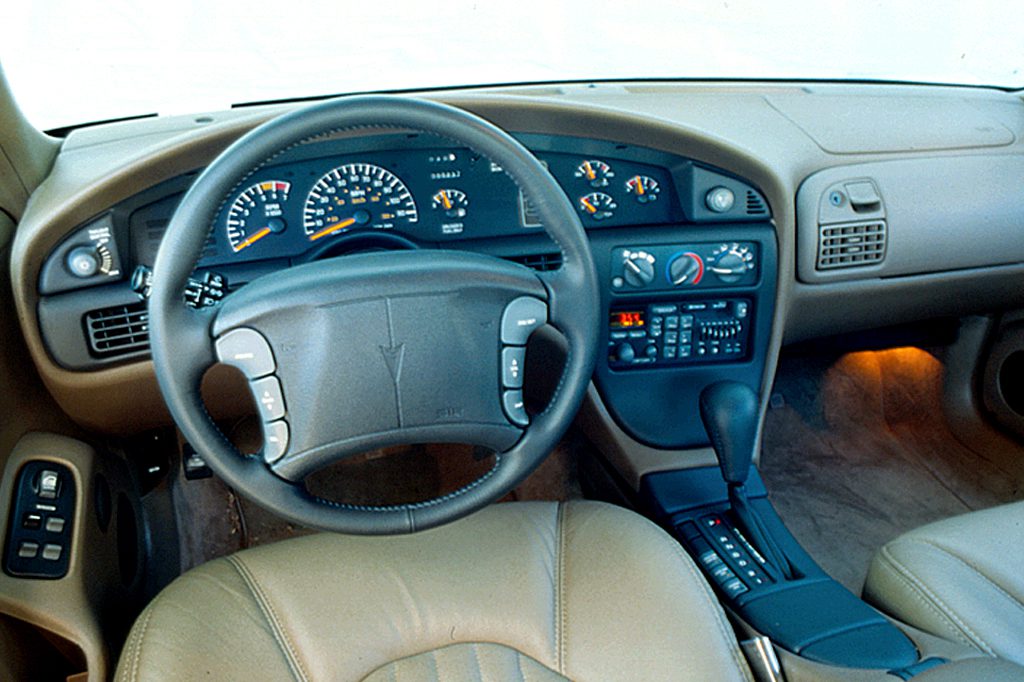
1992 Pontiac Bonneville SE interior
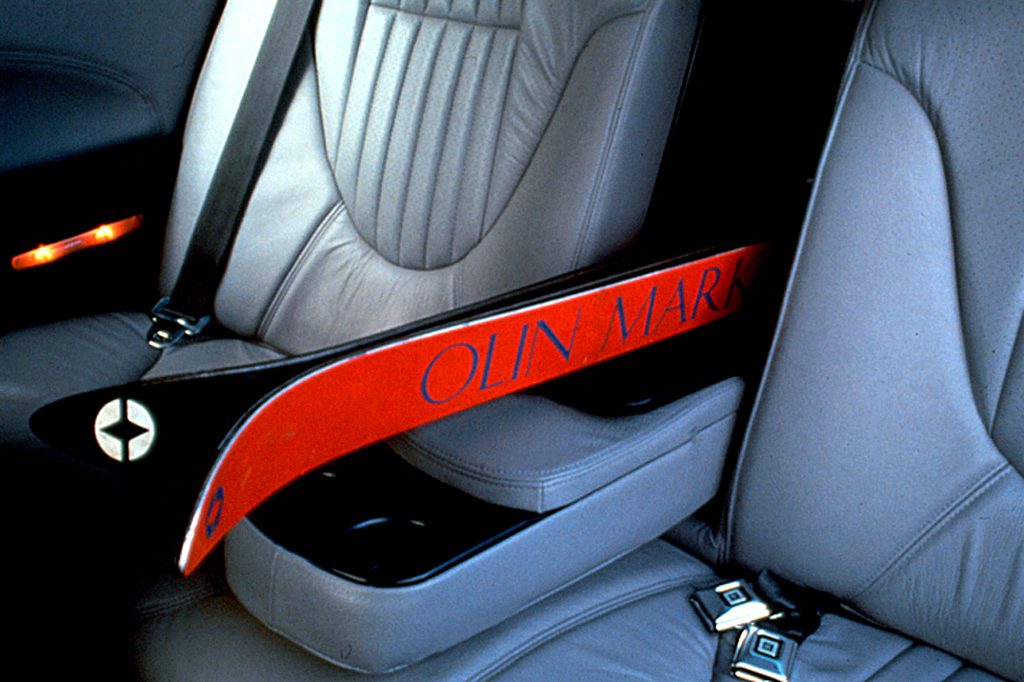
1992 Pontiac Bonneville SSEI interior
| Pros: |
|
| Cons: |
|
For ’92, Pontiac’s full-size front-drive sedan gained a fresh skin and plastic front fenders. While the Buick LeSabre and Oldsmobile Eighty Eight rode on the same basic platform, the Bonneville featured its own distinctive Pontiac “look.” Three trim levels were offered: SE, SSE, and SSEi. The base and midlevel models were provided with GM’s basic 3.8-liter V6, while the SSEi received the hotter supercharged version. All engines came paired with a 4-speed overdrive automatic transmission. SSEi models got dual airbags and antilock brakes. SE and SSE models made due with a driver-side airbag and optional antilock brakes.
[/vc_column_text][mk_table title=”Yearly Updates” style=”style2″ el_class=”used-yearly-updates”]| 1993 Bonneville Pontiac makes the supercharged V6 an available option for the midlevel SSE trim level for ’96 and all models now come equipped with antilock brakes as standard equipment. Both the SE and SSE get a 170-horsepower 3.8-liter V6, which receives 5 extra pound-feet of torque, now 225. |
| 1994 Bonneville All Bonnevilles get dual airbags and return in base SE trim and better-equipped SSE. However, the former SSEi has been relegated to a new SSEi Supercharger Package. Newly optional for the ’94 SSE models equipped with traction control is GM’s Computer Command Ride suspension. Designed specifically to reduce body lean and pitch, it automatically adjusts the suspension from soft to firm when cornering, accelerating, or stopping. |
| 1995 Bonneville The arrival of a more powerful standard engine heads the list of changes to the ’95 Bonneville. The new powerplant is a reengineered version of GM’s 3.8-liter V6, now dubbed the 3800 Series II. In this form, it provides 205 horsepower and 230 pound-feet of torque. |
| 1996 Bonneville Revised front and rear styling, plus more power for the available supercharged engine are the key changes to the ’96 Bonneville. |
| 1997 Bonneville The Bonneville returns virtually unchanged for 1997. |
| 1998 Bonneville Bonneville gets no major changes for 1998. |
| 1999 Bonneville Bonneville essentially stood pat for ’99 as an all-new model would arrive in 2000. |
[/vc_column_text][vc_column_text disable_pattern=”true” align=”left” margin_bottom=”24″ el_class=”used-powertrain-text”]Under the hood sits the same overhead-valve 3.8-liter V6 that has powered full-size GM cars since they were switched to front-wheel drive in 1986. However, GM adds more horsepower, with 1992 models featuring a 170-horsepower at 4800 rpm and 220 pound-feet of torque at 3200 rpm. For the sporty 1992-93 SSEi models, Pontiac provides a supercharged edition that delivers 205 horsepower at 4400 rpm and 260 pound-feet of torque at 2800 rpm. Both V6 engines come paired with an electronic 4-speed overdrive transmission. For 1993, torque on the base engine rises slightly to 225 pound-feet at 3200 rpm, with an all-new engine arriving in 1995. The new unit is a reengineered 3.8-liter, called the Series II 3800 V6. In its new form it delivers 205 horsepower–35 more than before–and 230 pound-feet of torque, up 5 from the previous version. For ’94, the more potent 225-horsepower supercharged edition of the V6 is available for those ordering the SSEi Supercharger Package. It provides 275 pound-feet of torque at 3600 rpm. Both engines remain teamed with an electronic 4-speed automatic transmission. For 1996, power for the optional supercharged engine jumps to 240 horsepower at 5200 rpm and 280 pound-feet of torque at 3200 rpm.[/vc_column_text][/vc_column_inner][vc_column_inner width=”1/2″][mk_table style=”style2″ el_class=”used-engine-specs”]
| ohv V6 | ||
| Engine Size (liters/cubic inches) | 3.8/231 | |
| Engine HP | 170 | |
| Engine Torque (lb-ft) | 200-225 | |
| Avail. Trans. | EPA MPG (city/hwy) | MPG avg. as tested |
| 4-speed automatic | 18/28 | |
| ohv V6 | ||
| Engine Size (liters/cubic inches) | 3.8/231 | |
| Engine HP | 205 | |
| Engine Torque (lb-ft) | 230 | |
| Avail. Trans. | EPA MPG (city/hwy) | MPG avg. as tested |
| 4-speed automatic | 19/29 | 17.0 |
| Supercharged ohv V6 | ||
| Engine Size (liters/cubic inches) | 3.8/231 | |
| Engine HP | 225-240 | |
| Engine Torque (lb-ft) | 275-280 | |
| Avail. Trans. | EPA MPG (city/hwy) | MPG avg. as tested |
| 4-speed automatic | 17/27 | 16.5 |
Even with the base engine, which currently delivers 205 horsepower, acceleration and passing response are brisk and sure. The supercharged version has all the feel of a burly V8, but requires the use of costlier premium unleaded. Expect real-world fuel economy of 17-18 in the city for the base engine, 25 on the highway. That drops to 15-16 city mileage for the supercharged version and 23-24 on the highway. Both engines team with an automatic that shifts promptly and smoothly. The CCR feature in the SSEi felt too loose and bouncy in Touring mode, and in Performance mode it failed to absorb bumps very well.
Bonneville has the same spacious interior and trunk as its more sedate siblings at Buick and Oldsmobile. There’s ample room for both passengers and cargo. The trunk is wide, has a flat floor that extends well-forward, providing 18 cubic feet of storage. Inside, the seating is comfortable and the instrument panel is well-executed.
[/vc_column_text][/vc_column_inner][vc_column_inner width=”1/2″][mk_content_box icon=”icon-road” heading=”Ratings” el_class=”ratings-box”][vc_column_text disable_pattern=”true” align=”left” margin_bottom=”18″]Model Tested: 1995 Pontiac Bonneville SLE[/vc_column_text][vc_column_text disable_pattern=”true” align=”left” margin_bottom=”18″ el_class=”review-slideshow-caption”]Ratings values are on a 1-10 scale, with 10 being the best. With the exception of Value, these numbers reflect how the vehicle compares against the universe of vehicles, not just against rivals in its class.[/vc_column_text][vc_column_text disable_pattern=”true” align=”left” margin_bottom=”0″ el_class=”used-performance-ratings” title=”Performance”][mk_skill_meter title=”Acceleration – 6″ percent=”60″ color=”#0bb697″][mk_skill_meter title=”Fuel Economy – 3″ percent=”30″ color=”#0bb697″][mk_skill_meter title=”Ride Quality – 6″ percent=”60″ color=”#0bb697″][mk_skill_meter title=”Steering/Handling – 6″ percent=”60″ color=”#0bb697″][mk_skill_meter title=”Quietness – 7″ percent=”70″ color=”#0bb697″][/vc_column_text][vc_column_text disable_pattern=”true” align=”left” margin_bottom=”0″ title=”Accommodations” el_class=”used-accomodations-ratings”][mk_skill_meter title=”Controls/Materials – 6″ percent=”60″ color=”#0bb697″][mk_skill_meter title=”Room/Comfort Front – 7″ percent=”70″ color=”#0bb697″][mk_skill_meter title=”Room/Comfort Rear – 5″ percent=”50″ color=”#0bb697″][mk_skill_meter title=”Cargo Room – 4″ percent=”40″ color=”#0bb697″][/vc_column_text][vc_column_text disable_pattern=”true” align=”left” margin_bottom=”0″ title=”Other” el_class=”used-other-ratings”][mk_skill_meter title=”Value – 6″ percent=”60″ color=”#0bb697″][/vc_column_text][vc_column_text disable_pattern=”true” align=”left” margin_bottom=”0″ el_class=”used-ratings-total”]Total: 56
[/vc_column_text][/mk_content_box][/vc_column_inner][/vc_row_inner][/vc_column][/mk_page_section][mk_page_section attachment=”scroll” bg_position=”left top” bg_repeat=”repeat” bg_stretch=”false” enable_3d=”false” speed_factor=”4″ bg_video=”no” video_mask=”false” video_opacity=”0.6″ top_shadow=”false” section_layout=”full” sidebar=”General” min_height=”100″ padding_top=”10″ padding_bottom=”10″ margin_bottom=”0″ first_page=”false” last_page=”true” section_id=”Specs”][vc_column width=”1/1″][vc_row_inner][vc_column_inner width=”1/2″][vc_column_text title=”Specifications” disable_pattern=”true” align=”left” margin_bottom=”0″][mk_table style=”style2″ el_class=”used-model-specs”]| 4-door sedan | ||||||||||||||||||||||||
| Wheelbase (in.) | Length (in.) | Width (in.) | Height (in.) | Weight (lbs) | ||||||||||||||||||||
| 110.8 | 200.6 | 74.5 | 55.7 | |||||||||||||||||||||
|
||||||||||||||||||||||||
Front Impact Test
[mk_skill_meter title=”Driver Injury – 5″ percent=”100″ color=”#0bb697″][mk_skill_meter title=”Front Passenger Injury – 3″ percent=”60″ color=”#0bb697″]Side Impact Test
[mk_skill_meter title=”Driver Injury – 3″ percent=”60″ color=”#0bb697″][mk_skill_meter title=”Rear Passenger Injury – 2″ percent=”40″ color=”#0bb697″][/vc_column_text][vc_column_text title=”HLDI” disable_pattern=”true” align=”left” margin_bottom=”0″ el_class=”used-hldi-ratings-head”] [/vc_column_text][mk_table style=”style2″ el_class=”used-hldi-ratings”]| Collision | 82 |
| Injury | 60 |
| Theft | 33 |
| Automatic transmission Description: 4T60E transmissions may drop out of drive while cruising; shift erratically; or have no second, third, or fourth gear because of a bad ground connection for the shift solenoids. (1992-94) |
| Automatic transmission Description: The 4T60E automatic transmission can suddenly go into neutral at highway speeds due to a problem with internal shift valves. (1995-97) |
| Coolant leak Description: The 3.8-liter V6 may leak coolant into the engine from the intake manifold. A new gasket kit, revised throttle body nuts, and sealing compound is available. Redesigned manifolds are also available in the aftermarket. (1993-99) |
| Coolant leak Description: Coolant loss via plastic intake manifold is corrected by installing upgraded manifold and gaskets plus new PCV kit. (1995-99) |
| Cruise control Description: If the cruise control doesn’t stay engaged, or drops out of cruise, the brake switch can usually be adjusted. (1992-95) |
| Engine noise Description: Bearing knock was common on many 3.3- and 3.8-liter engines due to too much clearance on the No. 1 main bearing. (1992-94) |
| Engine noise Description: A rattling noise from the engine when the car is started after sitting is often caused by automatic-transmission pump starvation, or a sticking pressure-regulator valve. (1992-95) |
| Engine temperature Description: Overheating and coolant loss may be due to rough surface on radiator filler neck. Neck should be sanded smooth and cap replaced. (1999) |
| Horn Description: The horn may spontaneously sound in cold weather. Airbag assembly must be replaced. (1999) |
| Oil consumption and engine knock Description: 3.8-liter engines are prone to excessive oil consumption often accompanied by spark knock due to failure of the valve-stem seals. (1993-95) |
| Steering noise Description: The upper-bearing mount in the steering column can get loose and cause a clicking, requiring a new bearing spring and turn-signal cancel cam. (1994-96) |
| Transaxle leak Description: The right front-axle seal at the automatic transaxle is prone to leak. GM issued a revised seal to correct the problem. (1992-94) |
| 1992 Description: Parking-brake lever may release one or more teeth when applied. |
| 1992 w/console shift Description: Control cable on some cars may disengage from bracket and falsely indicate gear position. |
| 1992-93 Description: Transmission-cooler line in cars with certain powertrains, sold in specified states, can separate at low temperature. |
| 1995 w/Twilight Sentinel Description: Excess current leakage can cause loss of headlights and parking lights. |
| 1996 Description: Damaged capacitor may cause failure of “Key in the Ignition” warning chime and driver-seatbelt-unbuckled warning chime and indicator lamp; other functions may also be impaired. |
| 1996 w/3.8-liter V6 Description: Backfire during engine starting can cause breakage of upper intake manifold, resulting in nonstart condition and possible fire. |
| 1997 Description: Seat cover trim on a few cars does not meet flammability requirements. |
| 1998-99 Description: A faulty fuel-pressure regulator may allow a fuel leak to enter the intake manifold, resulting in possible fire. Dealers will inspect and replace affected parts. |
| 1999 Description: Clip that secures linkage of transmission-detent lever can loosen and disconnect; indicated gear would then differ from actual state of the transmission. |
| 1999 w/chromed aluminum wheels Description: Studs on some wheels could break, causing tire/wheel assembly to separate. |