
| Minivan; Built in USA |
|
|
| Good condition price range: $2,500 – $4,700* |
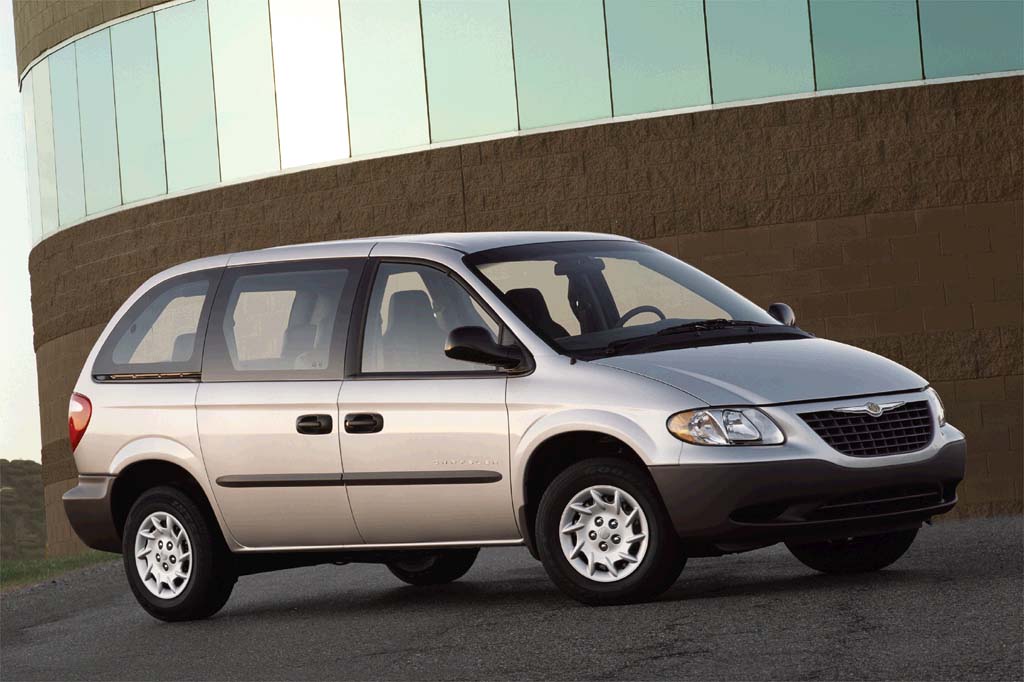
2002 Chrysler Voyager
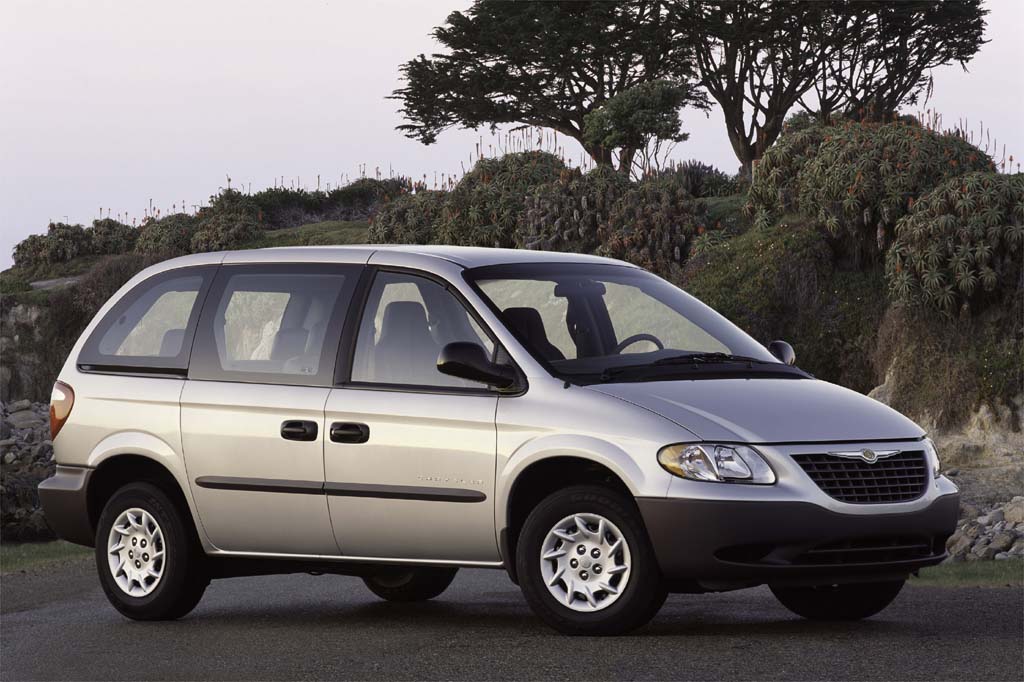
2003 Chrysler Voyager LX
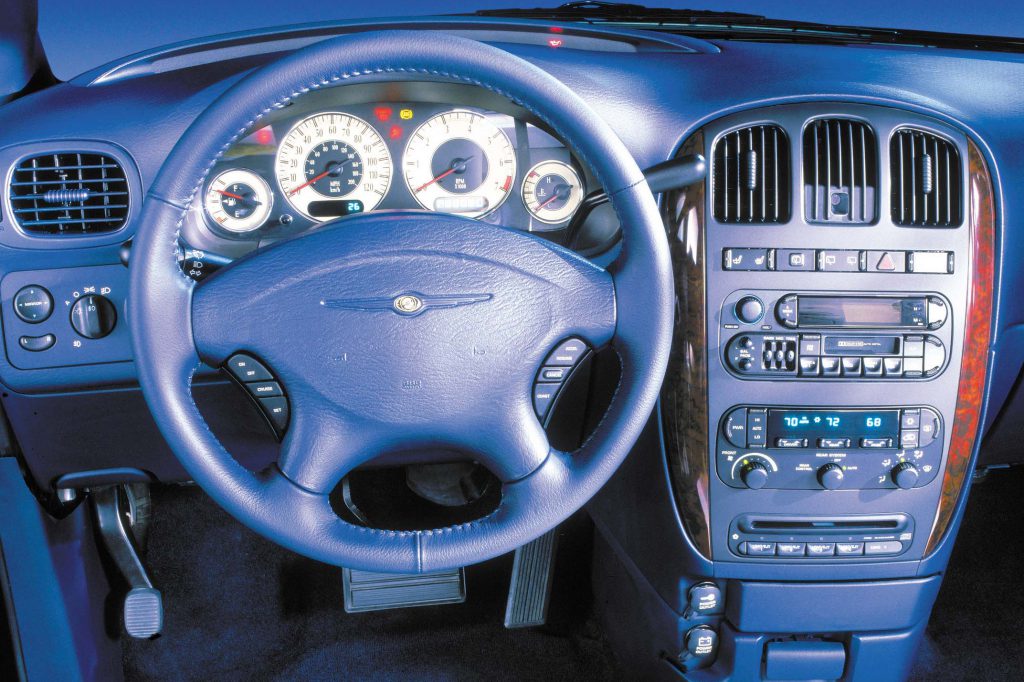
2003 Chrysler Voyager interior
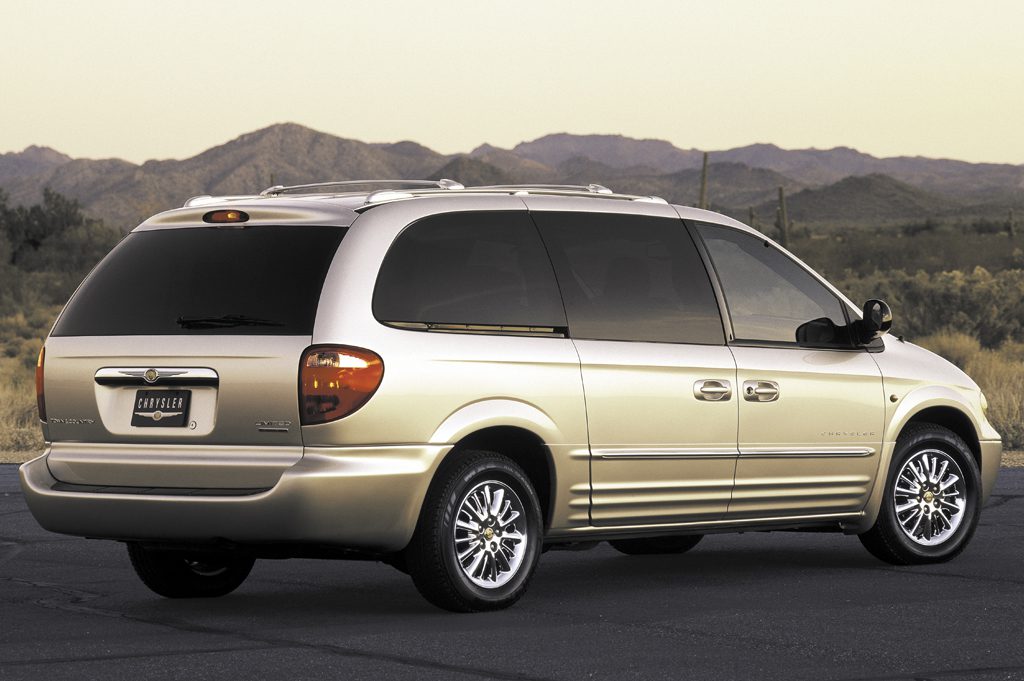
2003 Chrysler Voyager
| Pros: |
|
| Cons: |
|
New styling and more powerful engines marked the 2001 Voyager, the lower-priced cousin to Chrysler’s Town & Country minivan. Wheelbase was unchanged from 2000, though the Voyager was limited to the 113.3-inch chassis while the Town & Country rode an extended-length span. As in the past, Dodge Caravans shared this design and most mechanical features. Caravans also were redesigned for 2001, in both regular- and extended-length models.
New wraparound taillamps were installed, and headlights were 50-percent larger. These minivans were about 2 inches wider than the 1996-2000 models, with regular-length versions about 3 inches longer overall. Voyagers came in base and LX trim, both with front-wheel drive. A four-cylinder engine was standard in the base Voyager, and was unchanged from the 2000 power ratings. A 3.3-liter V6 was optional in the base Voyager, and standard in the Voyager LX. The V6 increased from 158 to 180 horsepower this year.
The four-cylinder engine teamed with a three-speed automatic transmission, while the V6 worked with a four-speed unit. Antilock brakes were optional on base Voyagers, and standard on the LX.
All models seat seven and have two sliding side doors, with power operation for the passenger-side door available for LX minivans. Alterations inside included new dashboards, and a center console with an internal power outlet and the capability of being mounted between the front or second-row seats.
Dashboard airbags gained dual-stage inflators. Front side airbags (a first for these vans) were optional. An available in-dash four-disc CD player also was new.
Unlike the Honda Odyssey and Mazda MPV, the third-row bench seat does not fold away into the floor, but Chrysler did offer a new 50-50 split third-row bench; each portion weighs 55 pounds and removes individually, and can also recline or fold flat.
Rivals included the Chevrolet Venture, Honda Odyssey, Toyota Sienna, and Ford Windstar. Following the demise of Plymouth, Voyager had joined Town & Country in the Chrysler-brand stable late in 1999.
[/vc_column_text][mk_table title=”Yearly Updates” style=”style2″ el_class=”used-yearly-updates”]| 2002 Voyager Either a VCR or a DVD-based rear-seat entertainment system could now be dealer-installed in Voyagers. This year’s lineup included a high-value entry-level model called the eC, as well as base and LX editions. All Voyagers now used a four-speed automatic transmission. |
| 2003 Voyager Power-adjustable brake and accelerator pedals were scheduled to join the options list during the 2003 model year. Antilock braking remained optional for the Voyager LX, but was no longer available for base-model Voyagers. |
[/vc_column_text][vc_column_text disable_pattern=”true” align=”left” margin_bottom=”24″ el_class=”used-powertrain-text”]A 2.4-liter four-cylinder engine went into base-model Voyagers, while the Voyager LX got a 3.3-liter V6. The V6 engine also was optional for the base model. Both engines drove a four-speed automatic transmission, except in the Voyager’s first season, when four-cylinder models used a three-speed unit.[/vc_column_text][/vc_column_inner][vc_column_inner width=”1/2″][mk_table style=”style2″ el_class=”used-engine-specs”]
| dohc I4 | ||
| Engine Size (liters/cubic inches) | 2.4/153 | |
| Engine HP | 150 | |
| Engine Torque (lb-ft) | 167 | |
| Avail. Trans. | EPA MPG (city/hwy) | MPG avg. as tested |
| 3-speed automatic 4-speed automatic |
20/26 20/24 |
|
| ohv V6 | ||
| Engine Size (liters/cubic inches) | 3.3/202 | |
| Engine HP | 180 | |
| Engine Torque (lb-ft) | 210 | |
| Avail. Trans. | EPA MPG (city/hwy) | MPG avg. as tested |
| 4-speed automatic | 18/24 | |
Considering a Voyager? Then go for the 3.3-liter V6, which furnishes the power required by a vehicle this size. Fuel economy is less than frugal with either engine.
Otherwise, the Voyager offers many of the benefits of Chrysler’s larger Town & Country minivan, and its Dodge Grand Caravan counterpart, for significantly fewer dollars. Still, there are important differences between the two Chrysler models, apart from their size.
Both versions are carlike and friendly, roomy and comfortable, with good steering feel. Ride quality is better in a Town & Country, but the Voyager isn’t harsh. Bigger wheels and tires give the Town & Country an edge over Voyager in handling and roadholding. Because of its shorter wheelbase, the Voyager tends to be jumpier, and less forgiving when rolling through bad pavement.
Stopping power with the Voyager is adequate, though short of the Town & Country’s with its antilock four-wheel disc setup. Voyagers rank as average in noise suppression, whereas the Town & Country is among the quietest minivans.
Voyager owners can expect a fine driving position. The Voyager’s shorter wheelbase results in just-adequate leg room in the second- and third-row positions, and in unexceptional cargo space with all seats in place.
Third-row seats remove easily, but are less convenient than back seats in minivans with stowable seating. The available power side door’s manual-override function is a surprising convenience. It stops and reverses direction quickly when encountering an obstruction. Chrysler’s revamped dashboard moved controls closer to the driver, but the front cupholders block access to the in-dash CD changer.
[/vc_column_text][/vc_column_inner][vc_column_inner width=”1/2″][mk_content_box icon=”icon-road” heading=”Ratings” el_class=”ratings-box”][vc_column_text disable_pattern=”true” align=”left” margin_bottom=”18″]Model Tested: 2001 chrysler Voyager LX w/3.3-liter V6[/vc_column_text][vc_column_text disable_pattern=”true” align=”left” margin_bottom=”18″ el_class=”review-slideshow-caption”]Ratings values are on a 1-10 scale, with 10 being the best. With the exception of Value, these numbers reflect how the vehicle compares against the universe of vehicles, not just against rivals in its class.[/vc_column_text][vc_column_text disable_pattern=”true” align=”left” margin_bottom=”0″ el_class=”used-performance-ratings” title=”Performance”][mk_skill_meter title=”Acceleration – 2″ percent=”20″ color=”#0bb697″][mk_skill_meter title=”Fuel Economy – 4″ percent=”40″ color=”#0bb697″][mk_skill_meter title=”Ride Quality – 4″ percent=”40″ color=”#0bb697″][mk_skill_meter title=”Steering/Handling – 4″ percent=”40″ color=”#0bb697″][mk_skill_meter title=”Quietness – 4″ percent=”40″ color=”#0bb697″][/vc_column_text][vc_column_text disable_pattern=”true” align=”left” margin_bottom=”0″ title=”Accommodations” el_class=”used-accomodations-ratings”][mk_skill_meter title=”Controls/Materials – 6″ percent=”60″ color=”#0bb697″][mk_skill_meter title=”Room/Comfort Front – 7″ percent=”70″ color=”#0bb697″][mk_skill_meter title=”Room/Comfort Rear – 6″ percent=”60″ color=”#0bb697″][mk_skill_meter title=”Cargo Room – 8″ percent=”80″ color=”#0bb697″][/vc_column_text][vc_column_text disable_pattern=”true” align=”left” margin_bottom=”0″ title=”Other” el_class=”used-other-ratings”][mk_skill_meter title=”Value – 7″ percent=”70″ color=”#0bb697″][/vc_column_text][vc_column_text disable_pattern=”true” align=”left” margin_bottom=”0″ el_class=”used-ratings-total”]Total: 52
[/vc_column_text][/mk_content_box][/vc_column_inner][/vc_row_inner][/vc_column][/mk_page_section][mk_page_section attachment=”scroll” bg_position=”left top” bg_repeat=”repeat” bg_stretch=”false” enable_3d=”false” speed_factor=”4″ bg_video=”no” video_mask=”false” video_opacity=”0.6″ top_shadow=”false” section_layout=”full” sidebar=”General” min_height=”100″ padding_top=”10″ padding_bottom=”10″ margin_bottom=”0″ first_page=”false” last_page=”true” section_id=”Specs”][vc_column width=”1/1″][vc_row_inner][vc_column_inner width=”1/2″][vc_column_text title=”Specifications” disable_pattern=”true” align=”left” margin_bottom=”0″][mk_table style=”style2″ el_class=”used-model-specs”]| 4-door van | ||||||||||||||||||||||||
| Wheelbase (in.) | Length (in.) | Width (in.) | Height (in.) | Weight (lbs) | ||||||||||||||||||||
| 113.3 | 189.1 | 78.6 | 68.9 | |||||||||||||||||||||
|
||||||||||||||||||||||||
Front Impact Test
[mk_skill_meter title=”Driver Injury – N/A” percent=”N/A0″ color=”#0bb697″][mk_skill_meter title=”Front Passenger Injury – N/A” percent=”N/A0″ color=”#0bb697″]Side Impact Test
[mk_skill_meter title=”Driver Injury – N/A” percent=”N/A0″ color=”#0bb697″][mk_skill_meter title=”Rear Passenger Injury – N/A” percent=”N/A0″ color=”#0bb697″][/vc_column_text][vc_column_text title=”HLDI” disable_pattern=”true” align=”left” margin_bottom=”0″ el_class=”used-hldi-ratings-head”] [/vc_column_text][mk_table style=”style2″ el_class=”used-hldi-ratings”]| Collision | N/A |
| Injury | N/A |
| Theft | N/A |
| Air conditioner Description: The A/C compressor may fail, causing a squealing or missing drive belt. The compressor fails from not turning on the rear A/C controls, but running only the front. After the A/C parts are replaced, the body- control computer requires reprogramming. (2001) |
| Doors Description: Loose weather strip tricks the power sliding door into thinking there is an obstruction making it misbehave during opening or closing. The weather strip must be replaced. (2001-02) |
| Engine stalling Description: The engine may lose power or stall, especially when the temperature is below freezing, requiring replacement of if the throttle-position sensor. (2001-02) |
| Fuel gauge Description: The fuel gauge may drop below the actual level while driving, but may return to the correct reading after sitting for about 10 minutes due to a kinked hose at the leak-detection pump filter. (2001-02) |
| Suspension noise Description: Knocking or squawking sounds from the front suspension are corrected by replacing the sway-bar links. (2001) |
| Water leak Description: Some early production (prior to April 2001) vehicles may have a serpentine belt that squeals of jumps off (in cold weather) the pulley caused by water leaking from the wiper module drain tube. In cold weather ice forms on the pulley. (2001) |
| Water leak Description: A wet passenger-side carpet is often due to condensation from the A/C drain tube blowing back into the passenger compartment. Replacing the tube with a longer one corrects the problem. (2001-02) |
| 2001-02 Description: Condensation from air conditioning ducts may drop through vent holes in top of radio, resulting in short-circuit that could lead to speaker fire. |
| 2002 Description: Some owner’s manuals are missing instructions for installing child seats. Owners will be provided with an addendum to the owners manual. |
| 2002-03 w/V6 engine Description: Upper power steering cooler hose on some minivans may split and cause fluid leakage, which could result in underhood fire. |